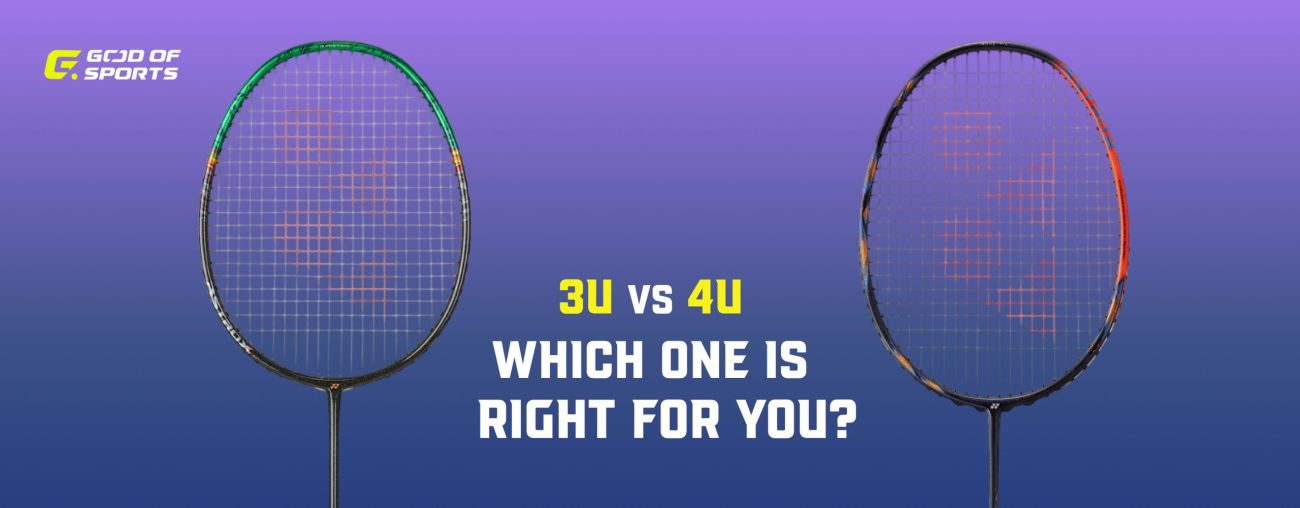
| Badminton is the sport we know most deeply at God of Sports — India is a badminton nation, and we’ve been selling racquets here long enough to see patterns that go well beyond what any spec sheet tells you. The 3U vs 4U question is the one most players don’t ask until they’ve already bought wrong. We’re here to make sure you don’t.
Our team has played badminton across skill levels. We’ve handed 3U racquets to players who should have been using 4U, watched what happened, and learned from it. We’ve had return conversations with customers where the weight choice — and only the weight choice — was the difference between a racquet that improved their game and one that hurt their arm. Everything in this guide comes from that experience. Not from reading spec sheets. From selling, playing, and listening. |
The Mistake That Costs Players Three Months of Progress
Real Story: Suresh from Chennai — the 3U mistake that caused tennis elbow |
| Suresh had been playing badminton for eight months, twice a week, at a club in Adyar. He was improving fast — his coach told him so. He came to us ready to upgrade from his beginner racquet. He’d done his research. He wanted the Yonex Astrox 99 Pro in 3U because he’d seen a review calling it ‘the best singles racquet available.’It is. For advanced players with two or more years of technique and strong forearm conditioning. Suresh had eight months.We advised against it. He was polite but firm — he bought it elsewhere. Six weeks later he was back. His elbow hurt every session. His smash — the shot he’d been developing beautifully — had actually gotten worse. He couldn’t finish long rallies because his arm was tired by the third game.The 3U frame (87–89g) requires more arm strength to swing at speed. An underdeveloped swing compounds the problem — you compensate by tensing up, which transmits more vibration into the joint. We’ve had this conversation more times than we can count. It almost always starts the same way: ‘I chose 3U because I thought heavier meant better.’Suresh eventually bought the Astrox 77 Pro in 4U. His smash came back within three sessions. His elbow healed in four weeks. |
This guide exists because of Suresh, and the dozens of players like him who came to us after making the same choice. The weight of a badminton racquet is not a prestige decision. It is a precision fit to your body, your game level, and your playing style — and getting it wrong has real costs.
Quick Answer — If You’re in a Hurry |
| Choose 4U if: You’re a beginner or intermediate player, you play doubles or mixed, you have any arm sensitivity, you play long sessions, or you’re a woman player. 4U is right for the majority of Indian badminton players.
Choose 3U if: You’re an advanced player with established technique, you play competitive singles, your game is built on the overhead smash, you have strong forearm conditioning, and you’ve been playing 2+ years. Beginner? Neither 3U nor 4U — look at 5U beginner racquets. The Yonex Astrox 7 (5U) is designed exactly for players who are learning. Build your technique first. |
What 3U and 4U Actually Mean — The Complete Explanation
The ‘U’ classification in badminton racquets is a Yonex-originated weight grading system that has become the industry standard across all brands. The number indicates the weight category:
- 5U = 75–79g (very light — beginner/junior)
- 4U = 80–84g (light — intermediate and most recreational)
- 3U = 85–89g (medium — advanced, power-focused)
- 2U = 90–94g (heavy — specialist, rarely used recreationally)
A difference of 5–9 grams sounds insignificant. It isn’t. When you swing a racquet at full speed, that mass difference is amplified significantly by the lever mechanics of your arm. A 5g difference at the racquet head translates to a considerably different force on your wrist and elbow over 200 swings in a match. For a player with underdeveloped forearm strength, those grams are the difference between a session that builds your game and one that strains your joint.
The Physics Explained Simply |
| Imagine swinging a cricket bat versus a tennis racquet. Both are manageable — but after 200 swings, the bat fatigues your arm far more, even though the weight difference feels modest when you hold them still. The same principle applies to 3U vs 4U. The weight difference is felt most acutely in long sessions and high-repetition strokes like smashes. This is why advanced players can use 3U and beginners shouldn’t. |
Full Head-to-Head Comparison
Specification |
3U (85–89g) |
4U (80–84g) |
| Weight range | 85–89g | 80–84g |
| Feel | Heavier, more solid, stable | Lighter, faster to swing, nimble |
| Natural power | Higher — momentum does the work | Lower — you generate it with technique |
| Swing speed | Slower (more mass to move) | Faster (less mass, quicker prep) |
| Arm fatigue | More fatigue over long sessions | Less fatigue — more sustainable |
| Smash power | Higher natural smash output | Needs full technique to smash hard |
| Net play / reflex shots | Slower to redirect | Fast — ideal for net kills, blocks |
| Injury risk (beginners) | Higher — elbow/wrist strain if weak | Lower — lighter on joints |
| String tension range | Can handle higher tension (24–30lb) | Better at moderate tension (20–26lb) |
| Best player type | Power smasher, rear-court singles | All-round, doubles, speed player |
| Popular examples | Yonex Astrox 99 Pro, Victor TK-F | Yonex Nanoflare 1000, Astrox 88D |
Situation Guide — Which Weight Wins What
Situation |
3U Wins |
4U Wins |
| Playing singles, rear-court dominant | ✅ | |
| Playing doubles, net player | ✅ | |
| Beginner or intermediate player | ✅ | |
| Long 2–3 hour sessions | ✅ | |
| Powerful overhead smash focus | ✅ | |
| Any arm, elbow, or wrist sensitivity | ✅ | |
| Fast net exchanges, quick rallies | ✅ | |
| Strong forearm strength, athletic build | ✅ | |
| Playing in women’s competitive format | ✅ | |
| Coming from tennis or squash | ✅ |
The Injury Risk Nobody Talks About
Why 3U Causes Elbow Problems in the Wrong Hands
Tennis elbow (lateral epicondylitis) from badminton is almost always caused by one of two things: incorrect technique, or incorrect racquet weight for the player’s current strength level. Often both together.
When a player without strong forearm conditioning swings a 3U racquet, they naturally compensate with wrist snap and elbow torque rather than shoulder-driven power. This places repeated stress on the lateral elbow attachment. Over weeks of twice-a-week play, that stress accumulates into pain that can sideline a player for months.
Real Story: Meera from Bangalore — the doubles player who bought a singles weapon |
| Meera is a doubles player. She plays mixed doubles three evenings a week with her husband at their apartment complex court. She plays net — quick hands, fast reflexes, winning points by intercepting and redirecting. Her husband covers the back court.She came to us wanting ‘the best racquet available for her level’ after seeing her friend’s Astrox 99 Pro. We asked her to describe three points she’d won recently. All three were net kills — fast, decisive, close-range. None involved an overhead smash.We explained: the 99 Pro in 3U is engineered for rear-court smashing. The weight and balance are optimised for overhead power generation. For her game — quick hands at the net — it’s actively wrong. She needs a lighter, head-light 4U frame that she can redirect faster.She bought the Nanoflare 1000 Game in 4U. Three months later she told us her net kill rate had noticeably improved. Her arm hadn’t hurt once. |
Important Buying Warning |
| If you already have elbow or wrist pain from badminton: stop and see a physiotherapist before buying any racquet. A weight change alone won’t fix an existing injury. Technique assessment is essential. Once cleared, 4U or 5U with lower string tension (18–22 lbs) is typically recommended by sports physios for recovery play. |
The Gender Question — Why Most Women Should Choose 4U
This is a topic most buying guides avoid. We’re going to address it directly because it matters for injury prevention and actual game performance.
On average, women have approximately 50–60% of the grip strength of men of similar athletic build. This is not a capability statement — women’s badminton at the elite level produces extraordinary power and technique. But at the recreational and developing-player level in India, the biomechanical reality is that most women players generate racquet speed more efficiently with a lighter 4U frame.
Elite women’s badminton professionals — including PV Sindhu at certain phases of her career — have used 4U racquets. The notion that ‘4U is for beginners’ is false. It’s for players whose swing mechanics produce the best results with that weight class.
For women recreational players in India: start with 4U. If after 18 months of regular play with coaching you feel the racquet isn’t giving you enough smash power, then — and only then — consider whether 3U would benefit your specific game.
Expert Tip |
| When female customers come to us asking about weight, we give them this framework: play with the racquet that lets you finish a full match without your arm feeling it the next morning. That is the right weight. For most women developing their game in India, that is 4U. |
Our Specific Racquet Recommendations by Weight
Full Racquet Lineup by Weight Class
Racquet |
Weight |
Balance |
Level |
Best For |
| Yonex Astrox 99 Pro | 4U (80–84g) | Head-Heavy | Advanced | Singles power smasher |
| Yonex Astrox 77 Pro | 4U (80–84g) | Head-Heavy | Int-Adv | All-round power, singles/doubles |
| Yonex Astrox 88D Pro | 4U (80–84g) | Head-Heavy | Advanced | Doubles attacker, back court |
| Yonex Nanoflare 1000 | 4U (80–84g) | Head-Light | Advanced | Doubles net, speed play |
| Yonex Nanoflare 800 Pro | 4U (80–84g) | Head-Light | Int-Adv | Doubles, quick net game |
| Victor Thruster K Falcon | 3U (85–89g) | Head-Heavy | Advanced | Power singles, full smash game |
| Li-Ning Axforce 90 | 4U (80–84g) | Mid-High | Adv | Chen Long style, all-round attack |
| Yonex Astrox 7 (beginner) | 5U (75–79g) | Head-Light | Beginner | Learning the game, arm-friendly |
Top 4U Pick — For Most Indian Badminton Players
TOP 4U PICK — INTERMEDIATE TO ADVANCED Yonex Astrox 77 Pro ~₹10,000–₹14,000 |
| 4U (80–84g) | Head-Heavy | Medium-Stiff Shaft | Rotational Generator System | Int-Advanced |
| The story: This is the racquet we recommended Suresh after his 3U mistake — and the one that fixed his game. The Astrox 77 Pro carries full Astrox DNA: the rotational weight distribution, the Namd fibre shaft, the power-generating balance point. But in 4U, it’s a racquet that a player with 6–18 months of developing technique can actually swing at full speed without compromising their arm. We’ve sold more of this racquet to players who’ve come to us with a story similar to Suresh’s than any other model. It’s consistently the racquet that feels right immediately — enough power to reward your developing smash, light enough to play a full match without the arm talking to you afterwards. |
| Buy it if: You’ve been playing 6 months to 2 years, want genuine Astrox performance, and know your game is power-oriented but you’re not yet at advanced competitive level.
Skip it if: You’re a pure beginner. Start with the Astrox 7 (5U) and build technique first. The 77 Pro is wasted on a player whose swing isn’t developed enough to use it.
|

| 4U SPEED PICK — DOUBLES & NET PLAYERS Yonex Nanoflare 1000 Game ~₹14,000–₹18,000 |
| 4U (80–84g) | Head-Light | Stiff | Nanocell Neo | Doubles Net Specialist |
| The story: For Meera — and for every doubles net player who reads her story and recognises themselves. The Nanoflare 1000 is the finest 4U racquet for speed-focused play we stock. Head-light balance combined with 4U weight means the fastest possible swing for reflex shots at the net. The Nanocell Neo technology creates a stiff, responsive frame that doesn’t flex on impact — every touch goes exactly where you direct it. If your game is built on quick hands, interceptions, and net kills rather than rear-court smashing, this is your racquet. It’s also the answer for any doubles player — male or female — whose role is primarily front court. |
| Buy it if: You play doubles front court, your game is speed and reflex-based, and you want the fastest possible racquet in the 4U class.
Skip it if: You play singles from the rear court and want smash power. You need head-heavy balance, not head-light. Shop Yonex Nanoflare 1000 Game →
|

Top 3U Pick — For the Right Advanced Player
TOP 3U PICK — ADVANCED SINGLES POWER PLAYER Yonex Astrox 99 Pro ~₹16,000–₹20,000 |
| 3U (80–84g) | Head-Heavy | Stiff | Namd Fibre | Advanced Singles |
| The story: This is PV Sindhu’s racquet. It’s the most powerful production racquet in the Yonex range. The 3U weight combined with head-heavy balance and Namd fibre shaft creates a smash that a technically complete player can weaponise completely. On a perfectly executed overhead, the momentum of the 3U frame carries through the shuttle with a force that a 4U racquet cannot match without significantly higher swing speed. For competitive club players and above — players who train consistently, have strong forearm conditioning, and describe the smash as their primary weapon — this is the benchmark. For everyone else, it’s the Suresh story waiting to happen. |
| Buy it if: You play competitive singles, you’ve been playing and training seriously for 2+ years, your forearm conditioning is developed, and your smash is your primary winning shot.
Skip it if: You’re under 18 months playing, you play doubles as a net player, or you have any existing elbow or wrist sensitivity. This racquet will punish all three situations.
|

The G (Grip Size) — Don’t Confuse It With Weight
Yonex racquets are labelled with both a U (weight) and a G (grip size). Players new to the system sometimes confuse them. They’re completely separate specifications.
- G4 = smaller grip circumference (approximately 82mm) — most common for Asian players
- G5 = even smaller (approximately 79mm) — for smaller hands, juniors, or players who prefer thinner grip
The G specification does not affect weight or swing — it only affects comfort and control of the handle. Most adult Indian players use G4. Players with smaller hands or who prefer a thin grip use G5 with an overgrip added for preferred thickness.
Expert Tip |
| When ordering from GOS, specify both U and G. A common order for an intermediate Indian male player is 4U G4 — light weight, standard Asian grip size. If you’re unsure about grip size, G4 with a single overgrip is the safest default. |
How Weight Interacts With String Tension
This is an advanced consideration that most buying guides skip. If you’re new to badminton, the quick version is: don’t string 3U racquets at high tension unless you’re an advanced player with correct technique. Here’s why:
Higher string tension increases control and shuttle speed — but it also reduces the forgiveness of the string bed and increases vibration transmitted to your arm on off-centre hits. A 3U racquet already places more stress on your joints than a 4U. Adding high tension (above 26 lbs) to a 3U frame creates a combination that punishes beginners and intermediates aggressively.
- Beginner on 4U or 5U: String at 18–22 lbs. Maximum forgiveness, arm-friendly.
- Intermediate on 4U: String at 22–26 lbs. Good power with manageable arm feel.
- Advanced on 3U: String at 24–30 lbs. Full performance range — but only for technically correct swings.
Real Story: The combination that caused the worst elbow case we’ve seen |
| A customer came to us last year describing the most severe badminton-related elbow pain we’d encountered from a recreational player. He’d bought a 3U racquet from a sports shop and asked them to string it ‘as tight as possible’ because he’d heard professionals use high tension. They strung it at 31 lbs.Heavy weight. Maximum tension. Developing technique. Three weeks of play.He was off badminton for four months under physiotherapist supervision. When he came back, we built his setup from scratch: 4U racquet, 20 lbs tension, technique coaching referral. He’s still playing today. But those four months were entirely preventable.If anyone tells you to string a 3U racquet at maximum tension as a recreational player, walk away. |
Frequently Asked Questions
Q: Does 3U mean better quality than 4U?
No — emphatically not. Weight class is a performance specification, not a quality indicator. A 4U Yonex Astrox 77 Pro is a superior racquet to a 3U no-brand frame in every measurable way. Weight class tells you the racquet’s weight, nothing about build quality, technology, or performance capability.
Q: PV Sindhu and other Indian players — what weight do they use?
Professional players typically use racquets customised to their exact specification, often different from retail versions. Sindhu has used different racquets at different career phases. At recreational level, the professional’s choice is less relevant than your own strength, style, and session frequency. Focus on fitting the weight to your game, not matching a professional.
Q: Can I add lead tape to a 4U racquet to make it feel like 3U?
Technically yes — lead tape at the head adds weight and head-heaviness. However, we’d advise against it for most players. The weight distribution of a factory racquet is engineered as a complete system. Adding tape in the wrong place creates an unbalanced frame. If you’ve genuinely outgrown 4U, buy a 3U instead of modifying. Modifications void warranty.
Q: My racquet doesn’t say 3U or 4U — how do I find out the weight?
Weigh it on a kitchen scale. Under 80g = 5U. 80–84g = 4U. 85–89g = 3U. Over 90g = 2U or heavier. If the racquet has no weight classification on the frame or documentation, it’s likely a budget racquet without standardised grading — consider this when evaluating its performance.
Q: Should children play with 4U or 5U?
5U or lighter — always. Junior-specific racquets in the 70–75g range exist for players under 12. The 5U (75–79g) Astrox 7 or Nanoflare 370 Speed are appropriate for teenagers developing their game. Never put a child on a 3U frame. The injury risk is serious and real.
Q: I play both singles and doubles — should I own two racquets?
Serious players who play both formats often do own two racquets: a 3U head-heavy for singles power and a 4U head-light for doubles net play. If you’re buying one racquet, the 4U all-round (like the Astrox 77 Pro) covers both formats adequately without specialising either way.
Q: Does weight matter less at beginner level because you’re not swinging hard?
The opposite is true. Beginners are learning swing mechanics and have less forearm conditioning. A lighter 4U or 5U racquet lets them develop correct technique without muscular compensation from handling too much weight. Starting heavy as a beginner is one of the most reliable ways to develop compensatory swing habits that are hard to unlearn.
Final Verdict — The GOS Decision Framework
Real Story: What we’ve learned from three years of weight-related conversations |
| If we tallied every customer who came back to us unhappy after buying the wrong weight, 3U-when-they-should-have-bought-4U accounts for more than 70% of those conversations. The reverse — 4U players who wish they’d bought 3U — is almost never a problem. Why? Because a player who’s genuinely ready for 3U will naturally outgrow 4U and upgrade. A player who buys 3U before they’re ready doesn’t just get a worse racquet experience — they get arm pain that keeps them off the court.Always err toward the lighter weight. You can upgrade when your game demands it. You can’t un-injure an elbow. |
The GOS Weight Decision |
| Beginner (under 6 months, learning technique): 5U — Astrox 7, Nanoflare 370 Speed. Build the swing first.
Intermediate player (6 months–2 years, 4U all-round): Astrox 77 Pro (4U) for power style. Nanoflare 1000 (4U) for speed/doubles. Advanced singles power player (2+ years, ready for 3U): Astrox 99 Pro (3U). Only if your technique is solid and your arm is conditioned. Women players, any level: Start 4U regardless of level. Upgrade only if your game specifically demands more smash momentum. Not sure? Message us on WhatsApp with how long you’ve played, your playing style, and whether you have any arm sensitivity. We’ll tell you in two minutes. |
Shop All Yonex Badminton Racquets →
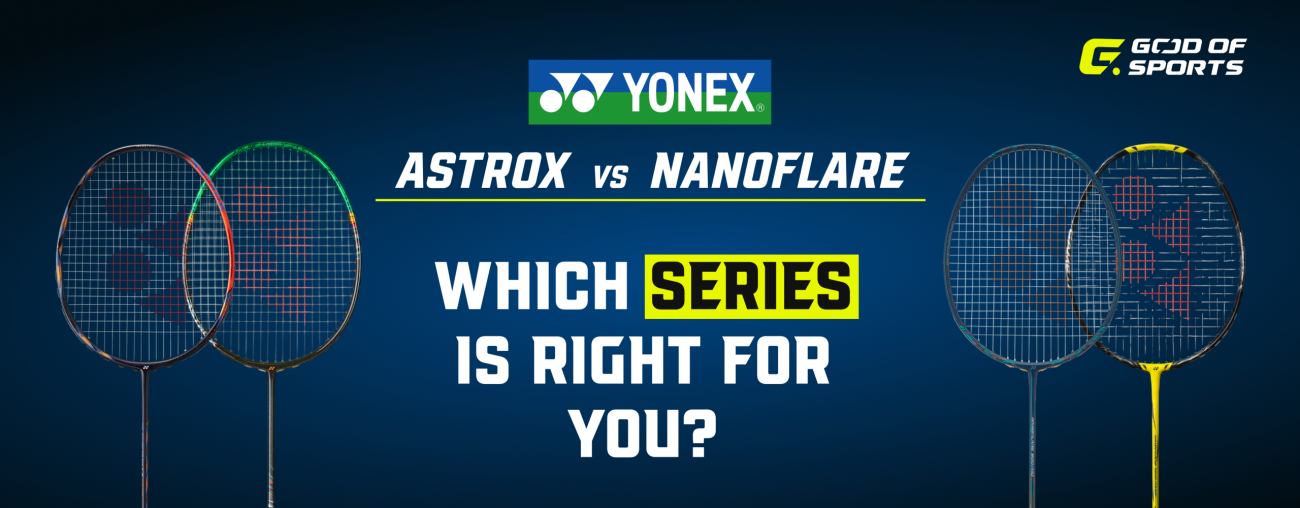
Related: Yonex Astrox vs Nanoflare — Which Series? →
Related: Best Badminton Racquets India 2026 →
Related: Badminton String Tension Guide →