Why Trust This Guide?
Pickleball balls are the most underestimated purchase decision in the sport. Players spend hours researching paddles and buy whatever balls are nearest to hand. We’ve watched players use tennis balls, badminton shuttle-case foam balls, and outdoor pickleball balls on indoor courts — each producing a completely different (and wrong) game. We’ve played on every major type of court surface available in Indian pickleball venues. This guide is built on that experience.
God of Sports stocks every major ball brand available in India. We’ve tested them on Indian courts, in Indian humidity, across the most common playing surfaces our customers use. What follows is not a spec comparison. It’s what we’ve actually observed.
Why Pickleball Balls Matter More Than You Think
Real Story: The Tournament That Taught Us This Lesson
A customer group from Hyderabad came to us six months ago — eight players who’d been practising together for four months, planning to enter their first local tournament. They’d been using budget no-brand balls because ‘the game is the same.’ At the tournament, the official balls were Franklin X-40s. They told us afterwards: ‘It felt like a completely different sport. The bounce was different. The speed was different. We kept hitting long because we were used to slower practice balls.’
We now recommend to every regular player: practice with the same balls you’ll play with in organised matches. The consistency matters.
Pickleball balls are not interchangeable. The ball you use on your Thursday night indoor session and the ball your club uses for its Saturday outdoor round-robin may play so differently that your instincts from practice become liabilities in the match. This is not overclaiming — it’s physics.
Here’s what changes between balls: the number and size of holes (determines wind resistance and bounce trajectory), the plastic material (determines hardness, durability, and crack resistance), the weight (determines carry in wind and impact feel), and the manufacturing precision (determines bounce consistency over time).
Indoor vs Outdoor Balls — The Most Important Decision
| Feature | Indoor Ball | Outdoor Ball |
| Number of holes | 26 holes (fewer, larger) | 40 holes (more, smaller) |
| Hole diameter | Larger openings | Smaller openings |
| Ball weight | Lighter | Slightly heavier |
| Surface texture | Smoother | Slightly textured/rougher |
| Why? | Indoor air is still ball needs less wind resistance design | Outdoor wind smaller holes reduce wind effect |
| Bounce behaviour | Softer, more float | Truer, less float |
| Can you use outdoors? | Bounces unpredictably in wind | Always |
Important Buying Warning
Using an outdoor ball on an indoor court (or vice versa) doesn’t just feel wrong — it teaches you wrong. Your third-shot drops will be calibrated to the wrong bounce trajectory. Your dink depth will be off. If you only play one format, buy the right ball for that format. If you play both, buy both. We stock both.
A Note on Indian Court Conditions
Indian pickleball is played on a wider variety of surfaces than most guides account for: wooden sports floors (indoor), synthetic courts, concrete rooftop courts, and outdoor hard courts. Surface hardness significantly affects ball durability. On rough outdoor concrete, balls crack faster — especially cheaper plastic. On wooden indoor courts, softer balls last longer but may feel dead sooner.
In Indian humidity, balls stored in hot environments (cars, outdoor bags in summer) can warp slightly. Store pickleball balls at room temperature. A warped ball will bounce inconsistently — that’s not the ball wearing out, it’s improper storage.
Our Top Pickleball Balls — Tested on Indian Courts
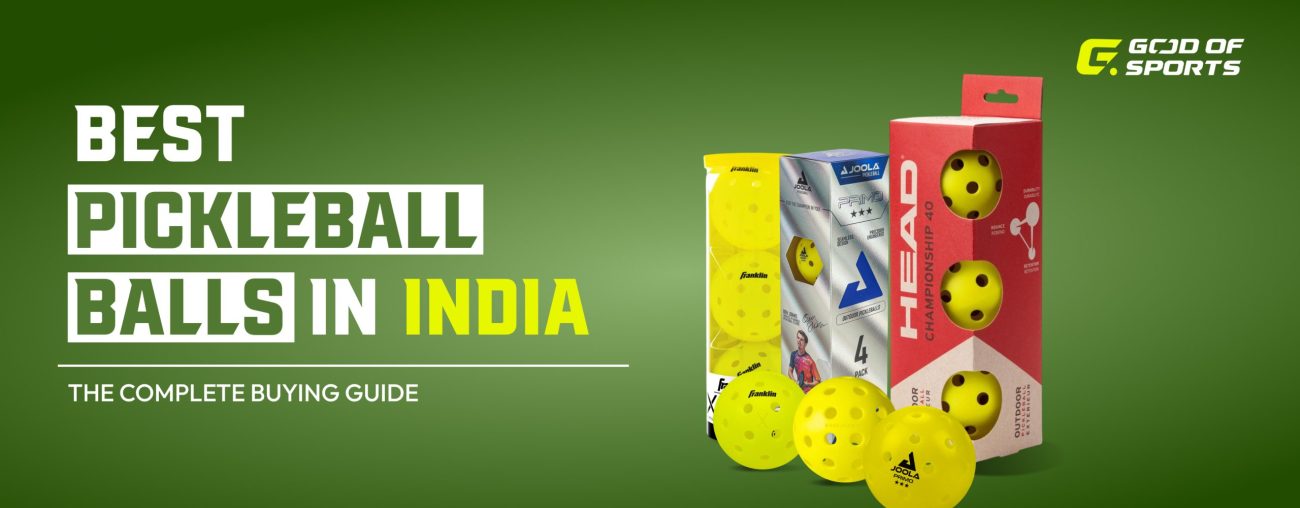
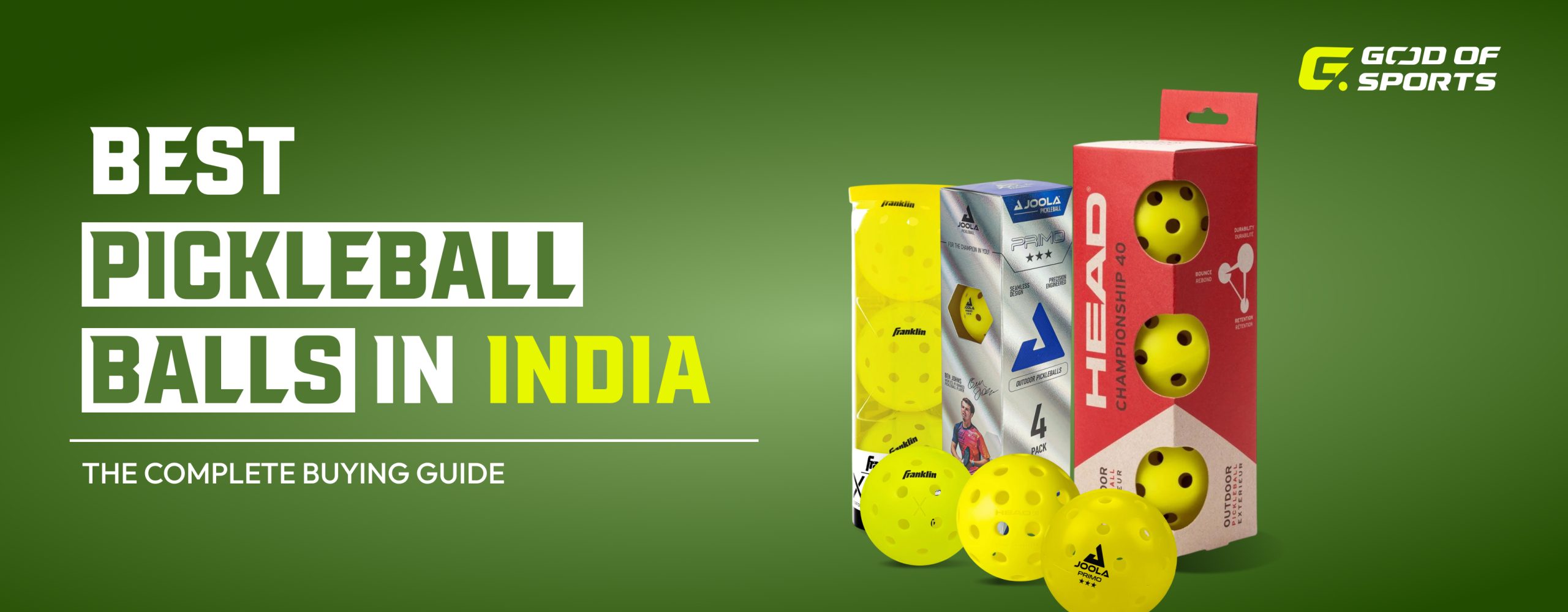
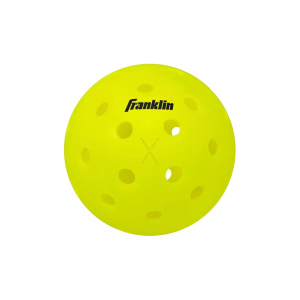
Top Pick — Outdoor & Tournament: Franklin X-40 Pickleball Ball
approximately ₹350–450 per ball (buy in sets of 6+) 40 Holes | Outdoor | USA Pickleball Approved | Hard Plastic | Available: Yellow & Orange
The story: The Franklin X-40 is the most commonly used tournament ball in the world. It is the official ball of USA Pickleball and the World Pickleball Tour. We stock it because our competitive customers demanded it — they want to practice with exactly what they’ll play with in any organised event. Our experience on Indian courts: it handles outdoor surfaces, including rough concrete and synthetic hard courts, better than any other ball we’ve tested. The seam construction holds up well in Indian heat. It bounces true and consistent from the first rally to the hundredth. We tell competitive players: this is your ball.
Buy it if: You compete in tournaments, you play outdoors, or you want a consistent practice experience that matches tournament play. Skip it if: You play exclusively on indoor wooden courts. The X-40’s construction is optimised for outdoor surfaces.
Shop Franklin X-40 Pickleball Balls →
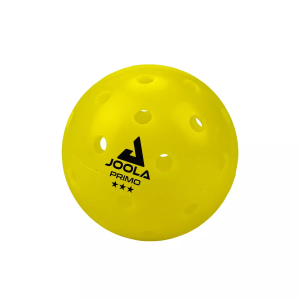
Top Pick — Indoor: JOOLA Primo Indoor Pickleball Ball
approximately ₹300–400 per ball 26 Holes | Indoor | USAPA Approved | Lighter Weight | Softer Bounce
The story: Indoor pickleball on wooden sports floors in India — the kind you find in badminton halls that have been adapted for pickleball — plays completely differently from outdoor concrete. The Primo is built for this: 26 larger holes give it the right flight characteristics for still indoor air, and the lighter construction produces the softer, more floaty bounce appropriate for wooden court surfaces. We’ve had customers in Bangalore who play at gym-converted indoor courts specifically request this ball because outdoor balls were cracking on the smooth floor. The Primo holds up well and maintains bounce consistency across a full session.
Buy it if: You play on indoor court surfaces — wooden floors, sports halls, gym conversions. You want the right ball for the right environment. Skip it if: You play outdoors. The Primo’s construction is wrong for outdoor surfaces and wind conditions.
Shop JOOLA Primo Indoor Ball →
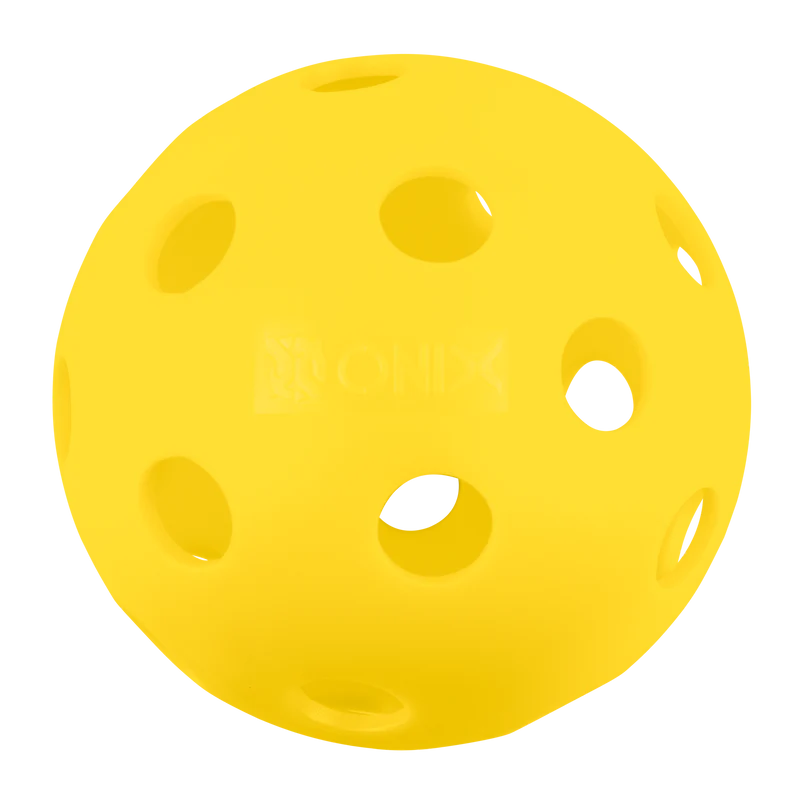
Best Value Practice: Onix Fuse Indoor/Outdoor Ball
approximately ₹200–300 per ball Indoor/Outdoor Hybrid | Softer Plastic | Good for Beginners | Lower cost per session
The story: The Onix Fuse is the ball we recommend to recreational groups and beginners who aren’t yet playing in tournaments and want something decent without spending ₹400 per ball on sessions where they’re still learning. It’s softer than the X-40 or Primo, which means it cracks more easily on rough surfaces, but for a group of eight friends playing twice a week on a synthetic court, it provides consistent enough bounce to learn the game properly. We buy these in bulk for GOS community events. They serve their purpose well.
Buy it if: You’re a beginner or recreational player, you play in a group and go through balls quickly, or you want practice balls at a lower cost. Skip it if: You compete or take pickleball seriously. Invest in proper X-40 or Primo balls for performance play.
Shop Onix Fuse Pickleball Balls →
Full Pickleball Ball Comparison
| Ball | Best For | Indoor/Outdoor | Durability | Price/Ball |
| Franklin X-40 | Outdoor, tournaments, general play | Outdoor | ⭐⭐⭐⭐⭐ | ~₹350–450 |
| JOOLA Primo | Indoor courts, control-focused | Indoor | ⭐⭐⭐⭐ | ~₹300–400 |
| Dura Fast 40 | Competitive, hard surface outdoor | Outdoor | ⭐⭐⭐⭐ | ~₹380–480 |
| Onix Fuse | Beginner, practice, all surfaces | Both | ⭐⭐⭐ | ~₹200–300 |
| HEAD Extreme | Outdoor aggressive play | Outdoor | ⭐⭐⭐⭐ | ~₹320–420 |
How Many Pickleball Balls Do You Need? The GOS Buying Formula
This is the question nobody asks until they’re buying wrong quantities and running out mid-session.
Recreational player (1–2 sessions/week, outdoor): Buy 6 balls minimum. Balls crack especially on rough outdoor surfaces. Having six means you finish the session even if two crack. Replace cracked balls immediately — a cracked ball bounces unpredictably and can injure players at close range.
Club/group play (3–4 players, regular sessions): Buy 12 balls per group. The standard format is 4–6 balls in active play per court, with backups for cracks and losses. Budget: ₹4,000–₹6,000 for a quality set that lasts a playing season.
Tournament or competitive preparation: Franklin X-40 only. Buy 12+ and practice exclusively with these. No exceptions if you want your practice to transfer.
Expert Tip
Buy balls in bulk packs — the per-ball cost drops significantly. A 6-pack of Franklin X-40 costs less per ball than buying them individually. We always stock bulk packs for this reason. Regular players who buy 12 at once spend significantly less over a season than those who buy 2 at a time.
When to Replace Your Pickleball Balls
Most players play with deteriorated balls far longer than they should. Here’s exactly when to retire a ball:
Visible crack — any crack, even hairline. Retire immediately. Cracked balls bounce unpredictably and can split on impact, sending shards into players’ faces at close range.
Egg-shaped — the ball has warped and is no longer spherical. Replace it.
Soft spots — you can feel a different texture or give in one part of the ball versus another. The seam or surface has compromised.
Consistent low bounce — the ball bounces noticeably lower than a new ball from the same pack. The material has fatigued.
Colour fading significantly — outdoor balls exposed to UV lose some surface integrity along with colour. Heavy fading on an outdoor ball means it’s been out long enough to check for soft spots.
Frequently Asked Questions
Can I use tennis balls or badminton shuttles for pickleball?
No. They play completely differently and will calibrate your instincts wrong. Tennis balls are too soft and bouncy. Badminton shuttles fly nothing like pickleball balls. Use proper pickleball balls from your first session.
How many holes does a proper pickleball ball have?
Outdoor balls have 40 holes. Indoor balls have 26 holes. This is standardised by USA Pickleball regulations. Any ball with a different hole count is not a regulation ball.
Do pickleball balls expire?
Yes. Even unused balls stored for years can lose their bounce consistency as the plastic ages. We recommend not buying more than a season’s worth at once unless you play very frequently.
Why do balls crack in Indian summer heat?
The plastic used in most pickleball balls becomes brittle at temperature extremes. In India’s summer, leaving balls in a car or direct sunlight can cause micro-stresses in the plastic. Store balls inside at room temperature.
Are coloured balls (orange, yellow, neon green) different in performance?
No — the colour is purely aesthetic. We carry yellow and orange X-40 balls. Some players find neon yellow easier to track against light backgrounds; orange is easier against green court surfaces. Performance is identical.
Are there cheaper Indian-made pickleball balls?
Some are available. Our experience: quality control is inconsistent, bounce is unreliable, and durability is shorter. For tournaments, USA Pickleball approved balls are required. For recreational play, we’ve seen frustration from clubs who bought cheap local balls only to replace them twice as often.
Final Verdict — The GOS Ball Buying Formula
Playing outdoors? → Franklin X-40. Buy 6+ at a time. This is the tournament standard.
Playing indoors? → JOOLA Primo. 26 holes, right weight, right bounce for indoor conditions. Just starting,
want value? → Onix Fuse. Decent quality, lower cost, good for learning the game.
Tournament prep? → Franklin X-40 exclusively. Practice with what you’ll compete with.
Related: 16mm vs 14mm Paddle Guide →