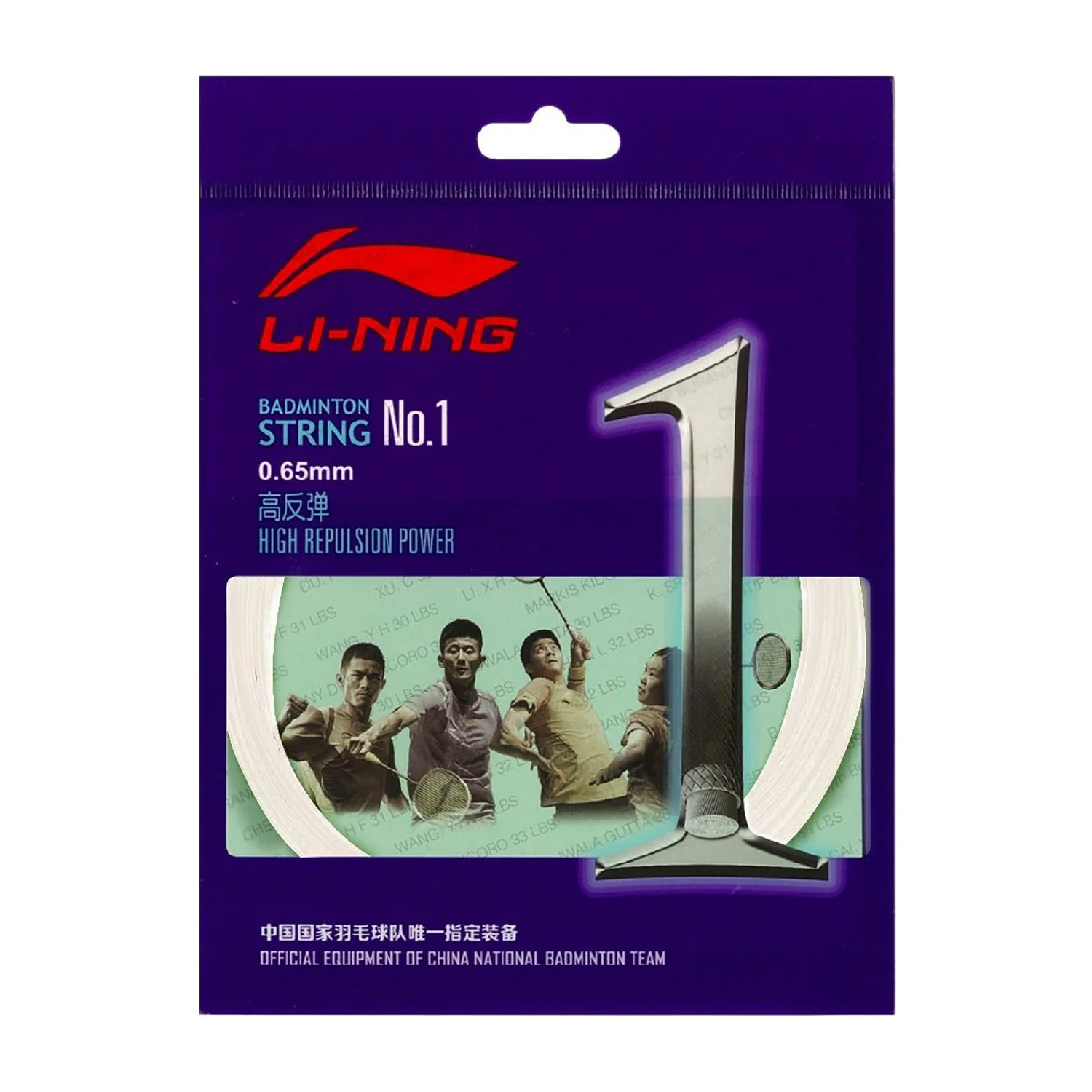





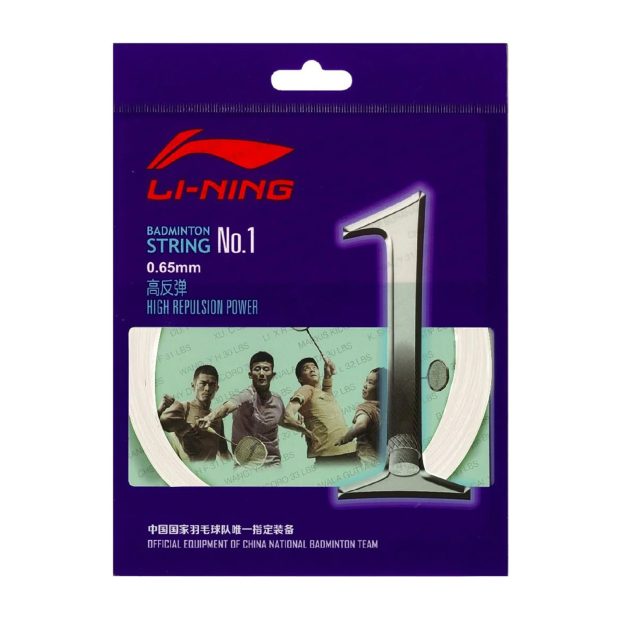
Li-Ning No 1 Badminton String
Li-Ning No 1 Badminton String is of 0.65mm gauge, with high repulsion, and hard feel. Heat resistant high-intensity nylon multifilament core and outer with Li-Ning’s 3D Knit technology for better durability than other 0.65mm strings.
₹750.00 Original price was: ₹750.00.₹692.00Current price is: ₹692.00.
Estimated Delivery Time: 2 - 4 Days (Delivery subject to pincode)
Estimated Delivery Time: 2 - 4 Days (Delivery subject to pincode)
Watch this video before Buying

Frequently Bought Together
[cuw_fbt]
Specification
Description
FAQ's
Specification
Description
God of Sports Expert Verdict on Li-Ning No 1 Badminton String:
- The Li-Ning No 1 Badminton String is the most played string in China’s national badminton programme — and that pedigree runs deep. Fu Hai Feng, PV Sindhu, and Kidambi Srikanth have all used it at world-class competitive level. This is not incidental: the No. 1’s combination of 0.65mm thinness, hard contact feel, high repulsion power, crisp acoustic response, and superior tension retention makes it a genuine alternative to the Yonex BG66 Ultimax in the Indian competitive club market — and in the specific area of tension retention, it is meaningfully better.
- The tension retention distinction is worth explaining precisely because it is the most practically important difference between the No. 1 and its closest Yonex equivalent. Yonex BG66 Ultimax loses tension relatively quickly — players who string it on Monday often feel a perceptible softening by Wednesday or Thursday. The No. 1’s 3D Knit technology interlocks the nylon filaments three-dimensionally, distributing impact stress more evenly and resisting the progressive loosening that affects simpler multifilament constructions at the same gauge. For intermediate to advanced club players who restring every 2–4 weeks, the No. 1 stays crisp and responsive for more of that cycle than the BG66 Ultimax does.
- The feel profile demands honest description: the Li-Ning No 1 Badminton String is hard. On contact, the shuttle leaves the string bed quickly and decisively — the feedback is crisp and immediate rather than soft and elastic. Players who have only used thicker strings (BG65, No. 7, VBS 70) will feel the difference dramatically on first use. The hardness is not a flaw — it is what gives the No. 1 its precision and acoustic clarity. Singles players in particular value hard feel for shot calibration: the string bed gives less “forgiveness” on mishits, but rewards precise contact with sharper placement and a more satisfying sound than softer alternatives.
- For Indian club players stepping up from BG65 or the Li-Ning No. 7, the Li-Ning No 1 Badminton String represents a substantial quality step: thinner gauge for more repulsion, harder feel for better control feedback, and a professional-level string that genuinely reflects how top players at national and international level string their rackets. At GOS’s accessible price, it is one of the best value performance strings on the market for players who are ready for it.
String Character Breakdown of Li-Ning No 1 Badminton String:
- Gauge — 0.65mm (Thin/Performance): 0.65mm places the Li-Ning No 1 Badminton String in the performance string category — significantly thinner than the 0.70mm durability standard (BG65, No. 7, VBS 70). Thinner strings produce more repulsion because the string bed deforms more on impact and rebounds faster, launching the shuttle at higher velocity for equivalent swing speed. The trade-off is lower durability — fewer individual fibres means each fibre carries more stress per impact. The No. 1’s 3D Knit construction partially compensates for this by improving fibre interlocking, but 0.65mm remains a string for players with consistent technique who can handle the fragility at the sweet spot.
- Core — Heat Resistant High-Intensity Nylon Multifilament: Thousands of individual nylon filaments twisted together form the No. 1’s core. Multifilament construction provides the elastic give that generates repulsion — the fibres flex collectively on impact and spring back to launch the shuttle. Heat resistance means the string’s properties remain consistent during play sessions where racket temperature rises from sustained impact. High-intensity nylon specification means the fibres are made from a stronger nylon grade with better fatigue resistance per fibre than standard nylon.
- Outer — Heat Resistant High-Intensity Nylon: The outer layer wraps the multifilament core, protecting the inner structure and providing the contact surface that touches the shuttle. The No. 1’s outer is smooth — no texture or coating — which produces the clean, direct feel on contact that characterises the string. Smooth outer surfaces provide less shuttle grip than textured alternatives, meaning the No. 1 prioritises repulsion over spin on net shots and slices.
- 3D Knit Technology — Durability Enhancement: Li-Ning’s proprietary braiding process interlocks the nylon filaments in three dimensions during manufacturing. Standard strings use two-dimensional wrapping; 3D Knit creates more contact points between fibres, distributing impact stress more evenly across the string’s cross-section. This makes the No. 1 more durable than other 0.65mm strings without adding gauge — a meaningful advantage for players who want thin string performance without paying the maximum durability penalty of ultra-thin alternatives.
- Feel — Hard: The Li-Ning No 1 Badminton String has a hard feel on contact — the shuttle departs the string bed quickly with minimal dwell time. Hard feel provides crisp, immediate feedback on every shot: the player hears a sharper, higher-pitched sound and feels direct contact through the racket. This characteristic is valued by advanced players for its contribution to shot control and confidence — particularly on smashes and drives where the decisive, instant launch of a hard-feel string produces more penetrating shuttle flight.
- Tension Retention — Above Average for 0.65mm: A defining advantage over BG66 Ultimax at comparable gauge. The 3D Knit construction and high-intensity nylon resist the progressive tension loss that affects simpler multifilament strings at this gauge. Players who string the Li-Ning No 1 Badminton String at 26–28 lbs find it maintains its crisp playing characteristics meaningfully longer than BG66 Ultimax does at the same tension.
Performance Ratings — Li-Ning No 1 Badminton String:
| Category | Score | Notes |
| Repulsion | 9.5 / 10 | 0.65mm thin gauge delivers very high repulsion — the shuttle launches fast and decisively from the string bed. One of the highest repulsion ratings in the Li-Ning range. Maximum benefit for players with fast, consistent swing technique who can strike near the sweet spot reliably. |
| Control | 8.5 / 10 | Hard feel and precise repulsion give excellent directional feedback on contact. Thin gauge means the effective contact area is smaller — shot placement is more exact. Particularly strong for placement smashes and cross-court drives. Net control is functional but lacks the shuttle-grip of textured strings for fine touch work. |
| Durability | 6.5 / 10 | Better than BG66 Ultimax at the same 0.65mm gauge thanks to 3D Knit, but not a durable string by absolute standards. Expect 3–6 weeks for intermediate club players at 24–26 lbs; 1–3 weeks for advanced players at 28+ lbs. Miss-hits and frame contact significantly reduce lifespan. Not for beginners or frequent string-breakers. |
| Feel | 9 / 10 | Hard, crisp, and decisive — the defining characteristic of the No. 1. Sharp acoustic response (high-pitched, satisfying hitting sound) and direct contact feedback make every shot feel authoritative and controlled. An acquired taste for players transitioning from soft-feel strings, but highly valued by advanced players once adapted. |
Tension Guide for Li-Ning No 1 Badminton String — Indian Courts:
- Club and Recreational Play — 22–26 lbs: The accessible tension range for the No. 1 in Indian club conditions. At 22–24 lbs, the string produces the most repulsion with the largest effective sweet spot — good for players transitioning from thicker strings who want the No. 1’s repulsion without the unforgiving precision demand of higher tension. At 24–26 lbs, the sweet spot tightens and the acoustic response sharpens — the best all-round tension for most intermediate club players.
- Competitive Club Play — 26–28 lbs: The ideal tension range for intermediate-to-advanced competitive players. The No. 1’s tension retention advantage over BG66 Ultimax is most clearly felt here — the string holds its crisp, hard feel at this tension for longer between restrings. Placement precision and smash penetration are both enhanced at this range. Most returning professional-level club players using the Li-Ning No 1 Badminton String settle in this bracket.
- Advanced Competitive Play — 28–30 lbs: The tension range used by national and international-level players. At 28–30 lbs, the sweet spot is significantly reduced — consistent technique is non-negotiable. Shuttle response is immediate and decisive. Durability drops sharply; restringing frequency increases. Only appropriate for players who train and compete at a level where string quality genuinely affects competitive outcomes.
- Do Not String Above 30 lbs: The Li-Ning No 1 Badminton String has a 30 lbs maximum. At 0.65mm, string beyond the ceiling significantly increases the risk of string breakage during play — even before the racket frame concerns arise. Always verify your racket’s stated tension ceiling equals or exceeds your intended string tension before stringing.
- Indian Conditions Note: India’s warm, humid climate (particularly coastal cities) keeps strings slightly more elastic than cool, dry conditions. Players in Mumbai, Chennai, and Kochi can typically string 1–2 lbs higher than their tension comfort zone at cooler venues and achieve the same playing feel. Players in air-conditioned halls should account for lower ambient temperature reducing string elasticity slightly.
String Finder — Is Li-Ning No 1 Badminton String Right for You?
- Intermediate to Advanced Club Player Who Wants Their First Performance String: You have been using BG65 or Li-Ning No. 7 and want a meaningful step up in repulsion and feel. The Li-Ning No 1 Badminton String is one of the most accessible entry points into genuine performance string territory — used by professionals, priced for club players, and the tension retention advantage over BG66 Ultimax makes it a more reliable daily performer at the 24–28 lbs range most Indian intermediate players use.
- Player Who Has Used BG66 Ultimax and Wants Something That Holds Tension Better: The No. 1’s most compelling argument in the Indian market. Same 0.65mm performance tier, hard feel versus BG66’s soft feel, significantly better tension retention. If the short-lived crispness of BG66 Ultimax frustrates you, the Li-Ning No 1 Badminton String solves that problem directly.
- Singles Player Who Wants Hard Feel and Smash Penetration: The Li-Ning No 1 Badminton String is more popular with singles players than doubles. Hard feel, decisive repulsion, and excellent smash direction feedback suit the long rallies and power exchanges of singles. Kidambi Srikanth’s use of this string reflects exactly this player profile.
- Doubles Player Choosing Between No. 1 and No. 1 Boost: For doubles play where softer feel is generally preferred for net touch and quick exchanges, the No. 1 Boost (0.66mm, slightly softer feel, better durability) is typically the better fit. The No. 1’s hard feel is most rewarding in the sustained baseline power exchanges of singles.
- Beginner or Frequent String-Breaker: Not the right choice. The Li-Ning No. 7 (0.70mm), No. 7 Boost, or Yonex BG65 provide the durability and forgiving feel that developing players need. Step up to the Li-Ning No 1 Badminton String when technique is consistent enough to contact the sweet spot reliably.
Playing Style Guide for Li-Ning No 1 Badminton String:
-
Power / Smash-First Players:
- Ideal Match. The No. 1’s hard feel and high repulsion are perfectly calibrated for power-first play — hard smashes, flat attacking drives, and decisive net kills all benefit from the string’s immediate, crisp contact response. The tension retention means smash quality remains consistent over a training session rather than degrading as the string loosens.
-
Control / Placement Players:
- Good Match. Hard feel and thin gauge provide excellent directional feedback for placement shots. String at 26–28 lbs for maximum control precision. The smooth outer limits shuttle grip on delicate net shots compared to textured alternatives, but for placement smashes and cross-court drives the Li-Ning No 1 Badminton String is excellent.
-
All-Court / Defensive Players:
- Moderate Match. The No. 1’s hard feel is demanding on defensive lifts and touch shots at the net — players who rely on softer, more elastic feel for defensive repulsion will find the No. 1’s immediacy challenging. The No. 1 Boost (softer feel) or Victor VBS 66 Nano are more forgiving alternatives for all-court play.
Li-Ning No 1 Badminton String vs Other Li-Ning Strings at God of Sports:
| Model | Gauge | Character | Feel | Best For |
| No. 1 (this string) | 0.65mm | High Repulsion | Hard | Singles power play, advanced club — crisp feel, best tension retention in family |
| No. 1 Boost | 0.66mm | Repulsion + Durability | Medium-Soft | Intermediate-advanced all-court — softer feel, better durability, more forgiving than No. 1 |
| No. 1 Rebound | 0.65mm | Repulsion + Elasticity | Medium-Crisp | Advanced players who want No. 1 thinness with springier, more elastic response |
| No. 7 | 0.70mm | Durability | Soft | Beginner–all levels — maximum durability, soft comfortable feel, Deep-Re-Dipping |
| No. 7 Boost | 0.70mm | Durability + Soft | Soft | Beginner–intermediate durability with 3D Knit enhancement |
| No. 7 Rebound | 0.70mm | Durability + Elasticity | Medium | Players who want No. 7 durability with improved elastic rebound |
Li-Ning No 1 Badminton String vs Similar Strings at God of Sports:
| Model | Brand | Gauge | Character | Feel | Best For |
| Li-Ning No. 1 (this string) | Li-Ning (China) | 0.65mm | High Repulsion | Hard | Hard feel, best tension retention at 0.65mm — singles power play |
| Yonex BG66 Ultimax | Yonex (Japan) | 0.65mm | High Repulsion | Soft | Softer elastic feel — better for players who prefer BG66 bounce. Loses tension faster than No. 1 |
| Yonex Exbolt 65 | Yonex (Japan) | 0.65mm | Repulsion + Durability | Crisp/Comfortable | Forged Fiber durability advantage over No. 1 at same gauge — the modern BG66 Ultimax replacement with better longevity |
| Victor VBS 66 Nano | Victor (Taiwan) | 0.66mm | Repulsion + Control | Medium | Nanotechnology construction, medium feel — more balanced between repulsion and control than No. 1’s hard repulsion focus |
- Li-Ning Badminton String at God of Sports
- All Badminton Strings at God of Sports
FAQ's
Shop Online
Shop 24/7 with your smartphone
Shipping Worldwide
Free Shipping All Over India
Pay on Delivery
You're in safe hands
Frequently Bought Together
[cuw_fbt]
Product Details
Specification
Description
FAQ's
Specification
Description
God of Sports Expert Verdict on Li-Ning No 1 Badminton String:
- The Li-Ning No 1 Badminton String is the most played string in China’s national badminton programme — and that pedigree runs deep. Fu Hai Feng, PV Sindhu, and Kidambi Srikanth have all used it at world-class competitive level. This is not incidental: the No. 1’s combination of 0.65mm thinness, hard contact feel, high repulsion power, crisp acoustic response, and superior tension retention makes it a genuine alternative to the Yonex BG66 Ultimax in the Indian competitive club market — and in the specific area of tension retention, it is meaningfully better.
- The tension retention distinction is worth explaining precisely because it is the most practically important difference between the No. 1 and its closest Yonex equivalent. Yonex BG66 Ultimax loses tension relatively quickly — players who string it on Monday often feel a perceptible softening by Wednesday or Thursday. The No. 1’s 3D Knit technology interlocks the nylon filaments three-dimensionally, distributing impact stress more evenly and resisting the progressive loosening that affects simpler multifilament constructions at the same gauge. For intermediate to advanced club players who restring every 2–4 weeks, the No. 1 stays crisp and responsive for more of that cycle than the BG66 Ultimax does.
- The feel profile demands honest description: the Li-Ning No 1 Badminton String is hard. On contact, the shuttle leaves the string bed quickly and decisively — the feedback is crisp and immediate rather than soft and elastic. Players who have only used thicker strings (BG65, No. 7, VBS 70) will feel the difference dramatically on first use. The hardness is not a flaw — it is what gives the No. 1 its precision and acoustic clarity. Singles players in particular value hard feel for shot calibration: the string bed gives less “forgiveness” on mishits, but rewards precise contact with sharper placement and a more satisfying sound than softer alternatives.
- For Indian club players stepping up from BG65 or the Li-Ning No. 7, the Li-Ning No 1 Badminton String represents a substantial quality step: thinner gauge for more repulsion, harder feel for better control feedback, and a professional-level string that genuinely reflects how top players at national and international level string their rackets. At GOS’s accessible price, it is one of the best value performance strings on the market for players who are ready for it.
String Character Breakdown of Li-Ning No 1 Badminton String:
- Gauge — 0.65mm (Thin/Performance): 0.65mm places the Li-Ning No 1 Badminton String in the performance string category — significantly thinner than the 0.70mm durability standard (BG65, No. 7, VBS 70). Thinner strings produce more repulsion because the string bed deforms more on impact and rebounds faster, launching the shuttle at higher velocity for equivalent swing speed. The trade-off is lower durability — fewer individual fibres means each fibre carries more stress per impact. The No. 1’s 3D Knit construction partially compensates for this by improving fibre interlocking, but 0.65mm remains a string for players with consistent technique who can handle the fragility at the sweet spot.
- Core — Heat Resistant High-Intensity Nylon Multifilament: Thousands of individual nylon filaments twisted together form the No. 1’s core. Multifilament construction provides the elastic give that generates repulsion — the fibres flex collectively on impact and spring back to launch the shuttle. Heat resistance means the string’s properties remain consistent during play sessions where racket temperature rises from sustained impact. High-intensity nylon specification means the fibres are made from a stronger nylon grade with better fatigue resistance per fibre than standard nylon.
- Outer — Heat Resistant High-Intensity Nylon: The outer layer wraps the multifilament core, protecting the inner structure and providing the contact surface that touches the shuttle. The No. 1’s outer is smooth — no texture or coating — which produces the clean, direct feel on contact that characterises the string. Smooth outer surfaces provide less shuttle grip than textured alternatives, meaning the No. 1 prioritises repulsion over spin on net shots and slices.
- 3D Knit Technology — Durability Enhancement: Li-Ning’s proprietary braiding process interlocks the nylon filaments in three dimensions during manufacturing. Standard strings use two-dimensional wrapping; 3D Knit creates more contact points between fibres, distributing impact stress more evenly across the string’s cross-section. This makes the No. 1 more durable than other 0.65mm strings without adding gauge — a meaningful advantage for players who want thin string performance without paying the maximum durability penalty of ultra-thin alternatives.
- Feel — Hard: The Li-Ning No 1 Badminton String has a hard feel on contact — the shuttle departs the string bed quickly with minimal dwell time. Hard feel provides crisp, immediate feedback on every shot: the player hears a sharper, higher-pitched sound and feels direct contact through the racket. This characteristic is valued by advanced players for its contribution to shot control and confidence — particularly on smashes and drives where the decisive, instant launch of a hard-feel string produces more penetrating shuttle flight.
- Tension Retention — Above Average for 0.65mm: A defining advantage over BG66 Ultimax at comparable gauge. The 3D Knit construction and high-intensity nylon resist the progressive tension loss that affects simpler multifilament strings at this gauge. Players who string the Li-Ning No 1 Badminton String at 26–28 lbs find it maintains its crisp playing characteristics meaningfully longer than BG66 Ultimax does at the same tension.
Performance Ratings — Li-Ning No 1 Badminton String:
| Category | Score | Notes |
| Repulsion | 9.5 / 10 | 0.65mm thin gauge delivers very high repulsion — the shuttle launches fast and decisively from the string bed. One of the highest repulsion ratings in the Li-Ning range. Maximum benefit for players with fast, consistent swing technique who can strike near the sweet spot reliably. |
| Control | 8.5 / 10 | Hard feel and precise repulsion give excellent directional feedback on contact. Thin gauge means the effective contact area is smaller — shot placement is more exact. Particularly strong for placement smashes and cross-court drives. Net control is functional but lacks the shuttle-grip of textured strings for fine touch work. |
| Durability | 6.5 / 10 | Better than BG66 Ultimax at the same 0.65mm gauge thanks to 3D Knit, but not a durable string by absolute standards. Expect 3–6 weeks for intermediate club players at 24–26 lbs; 1–3 weeks for advanced players at 28+ lbs. Miss-hits and frame contact significantly reduce lifespan. Not for beginners or frequent string-breakers. |
| Feel | 9 / 10 | Hard, crisp, and decisive — the defining characteristic of the No. 1. Sharp acoustic response (high-pitched, satisfying hitting sound) and direct contact feedback make every shot feel authoritative and controlled. An acquired taste for players transitioning from soft-feel strings, but highly valued by advanced players once adapted. |
Tension Guide for Li-Ning No 1 Badminton String — Indian Courts:
- Club and Recreational Play — 22–26 lbs: The accessible tension range for the No. 1 in Indian club conditions. At 22–24 lbs, the string produces the most repulsion with the largest effective sweet spot — good for players transitioning from thicker strings who want the No. 1’s repulsion without the unforgiving precision demand of higher tension. At 24–26 lbs, the sweet spot tightens and the acoustic response sharpens — the best all-round tension for most intermediate club players.
- Competitive Club Play — 26–28 lbs: The ideal tension range for intermediate-to-advanced competitive players. The No. 1’s tension retention advantage over BG66 Ultimax is most clearly felt here — the string holds its crisp, hard feel at this tension for longer between restrings. Placement precision and smash penetration are both enhanced at this range. Most returning professional-level club players using the Li-Ning No 1 Badminton String settle in this bracket.
- Advanced Competitive Play — 28–30 lbs: The tension range used by national and international-level players. At 28–30 lbs, the sweet spot is significantly reduced — consistent technique is non-negotiable. Shuttle response is immediate and decisive. Durability drops sharply; restringing frequency increases. Only appropriate for players who train and compete at a level where string quality genuinely affects competitive outcomes.
- Do Not String Above 30 lbs: The Li-Ning No 1 Badminton String has a 30 lbs maximum. At 0.65mm, string beyond the ceiling significantly increases the risk of string breakage during play — even before the racket frame concerns arise. Always verify your racket’s stated tension ceiling equals or exceeds your intended string tension before stringing.
- Indian Conditions Note: India’s warm, humid climate (particularly coastal cities) keeps strings slightly more elastic than cool, dry conditions. Players in Mumbai, Chennai, and Kochi can typically string 1–2 lbs higher than their tension comfort zone at cooler venues and achieve the same playing feel. Players in air-conditioned halls should account for lower ambient temperature reducing string elasticity slightly.
String Finder — Is Li-Ning No 1 Badminton String Right for You?
- Intermediate to Advanced Club Player Who Wants Their First Performance String: You have been using BG65 or Li-Ning No. 7 and want a meaningful step up in repulsion and feel. The Li-Ning No 1 Badminton String is one of the most accessible entry points into genuine performance string territory — used by professionals, priced for club players, and the tension retention advantage over BG66 Ultimax makes it a more reliable daily performer at the 24–28 lbs range most Indian intermediate players use.
- Player Who Has Used BG66 Ultimax and Wants Something That Holds Tension Better: The No. 1’s most compelling argument in the Indian market. Same 0.65mm performance tier, hard feel versus BG66’s soft feel, significantly better tension retention. If the short-lived crispness of BG66 Ultimax frustrates you, the Li-Ning No 1 Badminton String solves that problem directly.
- Singles Player Who Wants Hard Feel and Smash Penetration: The Li-Ning No 1 Badminton String is more popular with singles players than doubles. Hard feel, decisive repulsion, and excellent smash direction feedback suit the long rallies and power exchanges of singles. Kidambi Srikanth’s use of this string reflects exactly this player profile.
- Doubles Player Choosing Between No. 1 and No. 1 Boost: For doubles play where softer feel is generally preferred for net touch and quick exchanges, the No. 1 Boost (0.66mm, slightly softer feel, better durability) is typically the better fit. The No. 1’s hard feel is most rewarding in the sustained baseline power exchanges of singles.
- Beginner or Frequent String-Breaker: Not the right choice. The Li-Ning No. 7 (0.70mm), No. 7 Boost, or Yonex BG65 provide the durability and forgiving feel that developing players need. Step up to the Li-Ning No 1 Badminton String when technique is consistent enough to contact the sweet spot reliably.
Playing Style Guide for Li-Ning No 1 Badminton String:
-
Power / Smash-First Players:
- Ideal Match. The No. 1’s hard feel and high repulsion are perfectly calibrated for power-first play — hard smashes, flat attacking drives, and decisive net kills all benefit from the string’s immediate, crisp contact response. The tension retention means smash quality remains consistent over a training session rather than degrading as the string loosens.
-
Control / Placement Players:
- Good Match. Hard feel and thin gauge provide excellent directional feedback for placement shots. String at 26–28 lbs for maximum control precision. The smooth outer limits shuttle grip on delicate net shots compared to textured alternatives, but for placement smashes and cross-court drives the Li-Ning No 1 Badminton String is excellent.
-
All-Court / Defensive Players:
- Moderate Match. The No. 1’s hard feel is demanding on defensive lifts and touch shots at the net — players who rely on softer, more elastic feel for defensive repulsion will find the No. 1’s immediacy challenging. The No. 1 Boost (softer feel) or Victor VBS 66 Nano are more forgiving alternatives for all-court play.
Li-Ning No 1 Badminton String vs Other Li-Ning Strings at God of Sports:
| Model | Gauge | Character | Feel | Best For |
| No. 1 (this string) | 0.65mm | High Repulsion | Hard | Singles power play, advanced club — crisp feel, best tension retention in family |
| No. 1 Boost | 0.66mm | Repulsion + Durability | Medium-Soft | Intermediate-advanced all-court — softer feel, better durability, more forgiving than No. 1 |
| No. 1 Rebound | 0.65mm | Repulsion + Elasticity | Medium-Crisp | Advanced players who want No. 1 thinness with springier, more elastic response |
| No. 7 | 0.70mm | Durability | Soft | Beginner–all levels — maximum durability, soft comfortable feel, Deep-Re-Dipping |
| No. 7 Boost | 0.70mm | Durability + Soft | Soft | Beginner–intermediate durability with 3D Knit enhancement |
| No. 7 Rebound | 0.70mm | Durability + Elasticity | Medium | Players who want No. 7 durability with improved elastic rebound |
Li-Ning No 1 Badminton String vs Similar Strings at God of Sports:
| Model | Brand | Gauge | Character | Feel | Best For |
| Li-Ning No. 1 (this string) | Li-Ning (China) | 0.65mm | High Repulsion | Hard | Hard feel, best tension retention at 0.65mm — singles power play |
| Yonex BG66 Ultimax | Yonex (Japan) | 0.65mm | High Repulsion | Soft | Softer elastic feel — better for players who prefer BG66 bounce. Loses tension faster than No. 1 |
| Yonex Exbolt 65 | Yonex (Japan) | 0.65mm | Repulsion + Durability | Crisp/Comfortable | Forged Fiber durability advantage over No. 1 at same gauge — the modern BG66 Ultimax replacement with better longevity |
| Victor VBS 66 Nano | Victor (Taiwan) | 0.66mm | Repulsion + Control | Medium | Nanotechnology construction, medium feel — more balanced between repulsion and control than No. 1’s hard repulsion focus |
- Li-Ning Badminton String at God of Sports
- All Badminton Strings at God of Sports
FAQ's
Li-Ning No 1 (0.65mm): hardest feel, best tension retention, singles-dominant, original. Li-Ning No 1 Boost (0.66mm): three-layer with nano-braided core and elastic resin coating — softer feel, better durability, more forgiving. Li-Ning No 1 Rebound (0.65mm): same thin gauge as original but engineered for elasticity and springier feel. Choose by feel preference: hard, soft, or springy.
Same 0.65mm gauge tier, different feel and tension retention. No. 1 is harder and stiffer; BG66 Ultimax is softer and more elastic. No. 1 holds tension significantly longer — BG66 Ultimax is well-known for fast tension loss. Choose No. 1 for hard feel and lasting crispness; BG66 Ultimax for softer elastic feel.
God of Sports Expert Verdict on Li-Ning No 1 Badminton String:
- The Li-Ning No 1 Badminton String is the most played string in China’s national badminton programme — and that pedigree runs deep. Fu Hai Feng, PV Sindhu, and Kidambi Srikanth have all used it at world-class competitive level. This is not incidental: the No. 1’s combination of 0.65mm thinness, hard contact feel, high repulsion power, crisp acoustic response, and superior tension retention makes it a genuine alternative to the Yonex BG66 Ultimax in the Indian competitive club market — and in the specific area of tension retention, it is meaningfully better.
- The tension retention distinction is worth explaining precisely because it is the most practically important difference between the No. 1 and its closest Yonex equivalent. Yonex BG66 Ultimax loses tension relatively quickly — players who string it on Monday often feel a perceptible softening by Wednesday or Thursday. The No. 1’s 3D Knit technology interlocks the nylon filaments three-dimensionally, distributing impact stress more evenly and resisting the progressive loosening that affects simpler multifilament constructions at the same gauge. For intermediate to advanced club players who restring every 2–4 weeks, the No. 1 stays crisp and responsive for more of that cycle than the BG66 Ultimax does.
- The feel profile demands honest description: the Li-Ning No 1 Badminton String is hard. On contact, the shuttle leaves the string bed quickly and decisively — the feedback is crisp and immediate rather than soft and elastic. Players who have only used thicker strings (BG65, No. 7, VBS 70) will feel the difference dramatically on first use. The hardness is not a flaw — it is what gives the No. 1 its precision and acoustic clarity. Singles players in particular value hard feel for shot calibration: the string bed gives less “forgiveness” on mishits, but rewards precise contact with sharper placement and a more satisfying sound than softer alternatives.
- For Indian club players stepping up from BG65 or the Li-Ning No. 7, the Li-Ning No 1 Badminton String represents a substantial quality step: thinner gauge for more repulsion, harder feel for better control feedback, and a professional-level string that genuinely reflects how top players at national and international level string their rackets. At GOS’s accessible price, it is one of the best value performance strings on the market for players who are ready for it.
String Character Breakdown of Li-Ning No 1 Badminton String:
- Gauge — 0.65mm (Thin/Performance): 0.65mm places the Li-Ning No 1 Badminton String in the performance string category — significantly thinner than the 0.70mm durability standard (BG65, No. 7, VBS 70). Thinner strings produce more repulsion because the string bed deforms more on impact and rebounds faster, launching the shuttle at higher velocity for equivalent swing speed. The trade-off is lower durability — fewer individual fibres means each fibre carries more stress per impact. The No. 1’s 3D Knit construction partially compensates for this by improving fibre interlocking, but 0.65mm remains a string for players with consistent technique who can handle the fragility at the sweet spot.
- Core — Heat Resistant High-Intensity Nylon Multifilament: Thousands of individual nylon filaments twisted together form the No. 1’s core. Multifilament construction provides the elastic give that generates repulsion — the fibres flex collectively on impact and spring back to launch the shuttle. Heat resistance means the string’s properties remain consistent during play sessions where racket temperature rises from sustained impact. High-intensity nylon specification means the fibres are made from a stronger nylon grade with better fatigue resistance per fibre than standard nylon.
- Outer — Heat Resistant High-Intensity Nylon: The outer layer wraps the multifilament core, protecting the inner structure and providing the contact surface that touches the shuttle. The No. 1’s outer is smooth — no texture or coating — which produces the clean, direct feel on contact that characterises the string. Smooth outer surfaces provide less shuttle grip than textured alternatives, meaning the No. 1 prioritises repulsion over spin on net shots and slices.
- 3D Knit Technology — Durability Enhancement: Li-Ning’s proprietary braiding process interlocks the nylon filaments in three dimensions during manufacturing. Standard strings use two-dimensional wrapping; 3D Knit creates more contact points between fibres, distributing impact stress more evenly across the string’s cross-section. This makes the No. 1 more durable than other 0.65mm strings without adding gauge — a meaningful advantage for players who want thin string performance without paying the maximum durability penalty of ultra-thin alternatives.
- Feel — Hard: The Li-Ning No 1 Badminton String has a hard feel on contact — the shuttle departs the string bed quickly with minimal dwell time. Hard feel provides crisp, immediate feedback on every shot: the player hears a sharper, higher-pitched sound and feels direct contact through the racket. This characteristic is valued by advanced players for its contribution to shot control and confidence — particularly on smashes and drives where the decisive, instant launch of a hard-feel string produces more penetrating shuttle flight.
- Tension Retention — Above Average for 0.65mm: A defining advantage over BG66 Ultimax at comparable gauge. The 3D Knit construction and high-intensity nylon resist the progressive tension loss that affects simpler multifilament strings at this gauge. Players who string the Li-Ning No 1 Badminton String at 26–28 lbs find it maintains its crisp playing characteristics meaningfully longer than BG66 Ultimax does at the same tension.
Performance Ratings — Li-Ning No 1 Badminton String:
| Category | Score | Notes |
| Repulsion | 9.5 / 10 | 0.65mm thin gauge delivers very high repulsion — the shuttle launches fast and decisively from the string bed. One of the highest repulsion ratings in the Li-Ning range. Maximum benefit for players with fast, consistent swing technique who can strike near the sweet spot reliably. |
| Control | 8.5 / 10 | Hard feel and precise repulsion give excellent directional feedback on contact. Thin gauge means the effective contact area is smaller — shot placement is more exact. Particularly strong for placement smashes and cross-court drives. Net control is functional but lacks the shuttle-grip of textured strings for fine touch work. |
| Durability | 6.5 / 10 | Better than BG66 Ultimax at the same 0.65mm gauge thanks to 3D Knit, but not a durable string by absolute standards. Expect 3–6 weeks for intermediate club players at 24–26 lbs; 1–3 weeks for advanced players at 28+ lbs. Miss-hits and frame contact significantly reduce lifespan. Not for beginners or frequent string-breakers. |
| Feel | 9 / 10 | Hard, crisp, and decisive — the defining characteristic of the No. 1. Sharp acoustic response (high-pitched, satisfying hitting sound) and direct contact feedback make every shot feel authoritative and controlled. An acquired taste for players transitioning from soft-feel strings, but highly valued by advanced players once adapted. |
Tension Guide for Li-Ning No 1 Badminton String — Indian Courts:
- Club and Recreational Play — 22–26 lbs: The accessible tension range for the No. 1 in Indian club conditions. At 22–24 lbs, the string produces the most repulsion with the largest effective sweet spot — good for players transitioning from thicker strings who want the No. 1’s repulsion without the unforgiving precision demand of higher tension. At 24–26 lbs, the sweet spot tightens and the acoustic response sharpens — the best all-round tension for most intermediate club players.
- Competitive Club Play — 26–28 lbs: The ideal tension range for intermediate-to-advanced competitive players. The No. 1’s tension retention advantage over BG66 Ultimax is most clearly felt here — the string holds its crisp, hard feel at this tension for longer between restrings. Placement precision and smash penetration are both enhanced at this range. Most returning professional-level club players using the Li-Ning No 1 Badminton String settle in this bracket.
- Advanced Competitive Play — 28–30 lbs: The tension range used by national and international-level players. At 28–30 lbs, the sweet spot is significantly reduced — consistent technique is non-negotiable. Shuttle response is immediate and decisive. Durability drops sharply; restringing frequency increases. Only appropriate for players who train and compete at a level where string quality genuinely affects competitive outcomes.
- Do Not String Above 30 lbs: The Li-Ning No 1 Badminton String has a 30 lbs maximum. At 0.65mm, string beyond the ceiling significantly increases the risk of string breakage during play — even before the racket frame concerns arise. Always verify your racket’s stated tension ceiling equals or exceeds your intended string tension before stringing.
- Indian Conditions Note: India’s warm, humid climate (particularly coastal cities) keeps strings slightly more elastic than cool, dry conditions. Players in Mumbai, Chennai, and Kochi can typically string 1–2 lbs higher than their tension comfort zone at cooler venues and achieve the same playing feel. Players in air-conditioned halls should account for lower ambient temperature reducing string elasticity slightly.
String Finder — Is Li-Ning No 1 Badminton String Right for You?
- Intermediate to Advanced Club Player Who Wants Their First Performance String: You have been using BG65 or Li-Ning No. 7 and want a meaningful step up in repulsion and feel. The Li-Ning No 1 Badminton String is one of the most accessible entry points into genuine performance string territory — used by professionals, priced for club players, and the tension retention advantage over BG66 Ultimax makes it a more reliable daily performer at the 24–28 lbs range most Indian intermediate players use.
- Player Who Has Used BG66 Ultimax and Wants Something That Holds Tension Better: The No. 1’s most compelling argument in the Indian market. Same 0.65mm performance tier, hard feel versus BG66’s soft feel, significantly better tension retention. If the short-lived crispness of BG66 Ultimax frustrates you, the Li-Ning No 1 Badminton String solves that problem directly.
- Singles Player Who Wants Hard Feel and Smash Penetration: The Li-Ning No 1 Badminton String is more popular with singles players than doubles. Hard feel, decisive repulsion, and excellent smash direction feedback suit the long rallies and power exchanges of singles. Kidambi Srikanth’s use of this string reflects exactly this player profile.
- Doubles Player Choosing Between No. 1 and No. 1 Boost: For doubles play where softer feel is generally preferred for net touch and quick exchanges, the No. 1 Boost (0.66mm, slightly softer feel, better durability) is typically the better fit. The No. 1’s hard feel is most rewarding in the sustained baseline power exchanges of singles.
- Beginner or Frequent String-Breaker: Not the right choice. The Li-Ning No. 7 (0.70mm), No. 7 Boost, or Yonex BG65 provide the durability and forgiving feel that developing players need. Step up to the Li-Ning No 1 Badminton String when technique is consistent enough to contact the sweet spot reliably.
Playing Style Guide for Li-Ning No 1 Badminton String:
-
Power / Smash-First Players:
- Ideal Match. The No. 1’s hard feel and high repulsion are perfectly calibrated for power-first play — hard smashes, flat attacking drives, and decisive net kills all benefit from the string’s immediate, crisp contact response. The tension retention means smash quality remains consistent over a training session rather than degrading as the string loosens.
-
Control / Placement Players:
- Good Match. Hard feel and thin gauge provide excellent directional feedback for placement shots. String at 26–28 lbs for maximum control precision. The smooth outer limits shuttle grip on delicate net shots compared to textured alternatives, but for placement smashes and cross-court drives the Li-Ning No 1 Badminton String is excellent.
-
All-Court / Defensive Players:
- Moderate Match. The No. 1’s hard feel is demanding on defensive lifts and touch shots at the net — players who rely on softer, more elastic feel for defensive repulsion will find the No. 1’s immediacy challenging. The No. 1 Boost (softer feel) or Victor VBS 66 Nano are more forgiving alternatives for all-court play.
Li-Ning No 1 Badminton String vs Other Li-Ning Strings at God of Sports:
| Model | Gauge | Character | Feel | Best For |
| No. 1 (this string) | 0.65mm | High Repulsion | Hard | Singles power play, advanced club — crisp feel, best tension retention in family |
| No. 1 Boost | 0.66mm | Repulsion + Durability | Medium-Soft | Intermediate-advanced all-court — softer feel, better durability, more forgiving than No. 1 |
| No. 1 Rebound | 0.65mm | Repulsion + Elasticity | Medium-Crisp | Advanced players who want No. 1 thinness with springier, more elastic response |
| No. 7 | 0.70mm | Durability | Soft | Beginner–all levels — maximum durability, soft comfortable feel, Deep-Re-Dipping |
| No. 7 Boost | 0.70mm | Durability + Soft | Soft | Beginner–intermediate durability with 3D Knit enhancement |
| No. 7 Rebound | 0.70mm | Durability + Elasticity | Medium | Players who want No. 7 durability with improved elastic rebound |
Li-Ning No 1 Badminton String vs Similar Strings at God of Sports:
| Model | Brand | Gauge | Character | Feel | Best For |
| Li-Ning No. 1 (this string) | Li-Ning (China) | 0.65mm | High Repulsion | Hard | Hard feel, best tension retention at 0.65mm — singles power play |
| Yonex BG66 Ultimax | Yonex (Japan) | 0.65mm | High Repulsion | Soft | Softer elastic feel — better for players who prefer BG66 bounce. Loses tension faster than No. 1 |
| Yonex Exbolt 65 | Yonex (Japan) | 0.65mm | Repulsion + Durability | Crisp/Comfortable | Forged Fiber durability advantage over No. 1 at same gauge — the modern BG66 Ultimax replacement with better longevity |
| Victor VBS 66 Nano | Victor (Taiwan) | 0.66mm | Repulsion + Control | Medium | Nanotechnology construction, medium feel — more balanced between repulsion and control than No. 1’s hard repulsion focus |
- Li-Ning Badminton String at God of Sports
- All Badminton Strings at God of Sports
Li-Ning No 1 (0.65mm): hardest feel, best tension retention, singles-dominant, original. Li-Ning No 1 Boost (0.66mm): three-layer with nano-braided core and elastic resin coating — softer feel, better durability, more forgiving. Li-Ning No 1 Rebound (0.65mm): same thin gauge as original but engineered for elasticity and springier feel. Choose by feel preference: hard, soft, or springy.
Same 0.65mm gauge tier, different feel and tension retention. No. 1 is harder and stiffer; BG66 Ultimax is softer and more elastic. No. 1 holds tension significantly longer — BG66 Ultimax is well-known for fast tension loss. Choose No. 1 for hard feel and lasting crispness; BG66 Ultimax for softer elastic feel.
Customer Reviews
Products from same brand
Joola Tyson McGuffin Magnus 3S Pickleball Paddle (14 mm)
Joola Agassi Edge Heat Vision Pickleball Paddle (Flash Yellow)
Joola Kosmos Pro V Pickleball Paddle (16mm)
Similar Products
Victor A970 TD IN AX Badminton Shoes (White)
Asics Gel Rocket 11 Badminton Shoes (Black/White)
Apacs Nanofusion Speed 9000 Ultra Badminton Racket (Red/Blue)
Victor VG2 Ace Badminton Shoes (Black)
YONEX Duora 10 (Orange/Blue) Badminton Racket
Li-Ning Ignite 8 Badminton Racket (Cool Gray/Bull Red)
Yonex Tour Skill 2 Badminton Shoes (Poppy Red/Cobalt)
Victor Thruster Ryuga II TD Badminton Racket
Recently Viewed
God's Advice

Best Padel Racquet in India 2026
By
Sports Analyst
March 24, 2026
Best Badminton Racquet for Beginners in India 2026
By
Sports Analyst
March 24, 2026
Best Pickleball Balls in India 2026
By
Sports Analyst
February 27, 2026