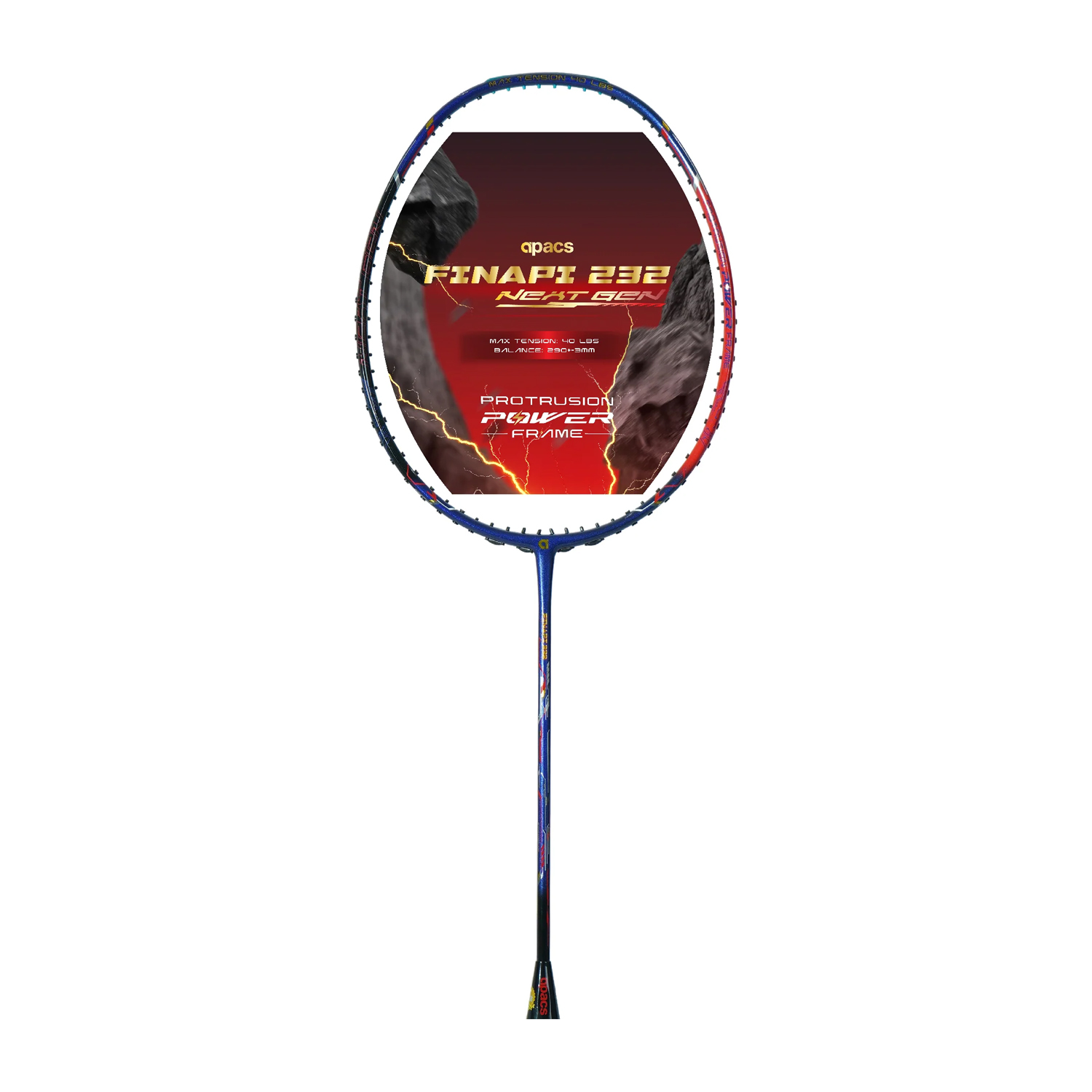


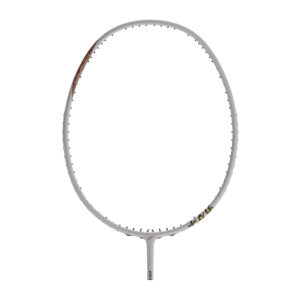
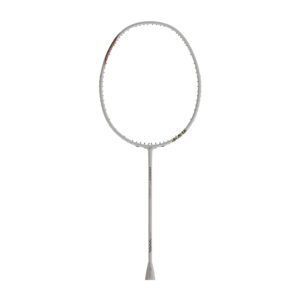
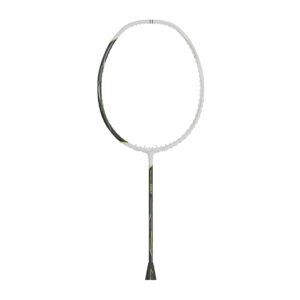
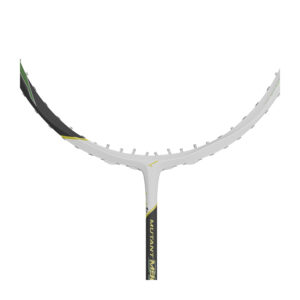



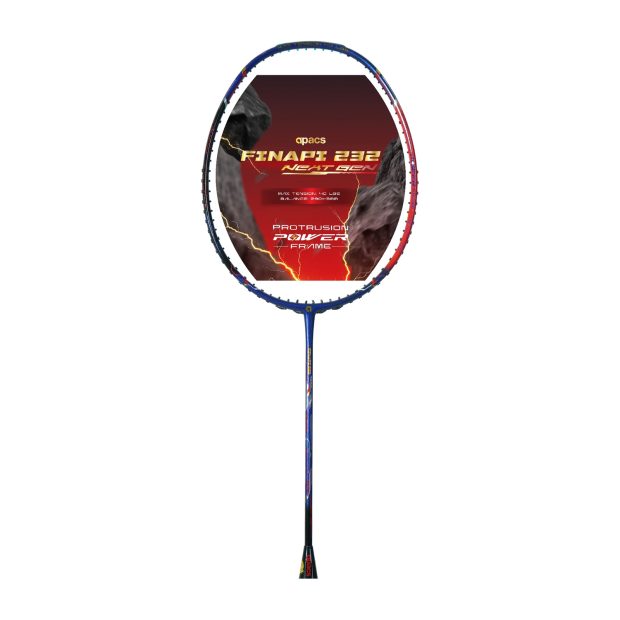
Apacs Finapi 232 Next Gen Badminton Racket (Navy)
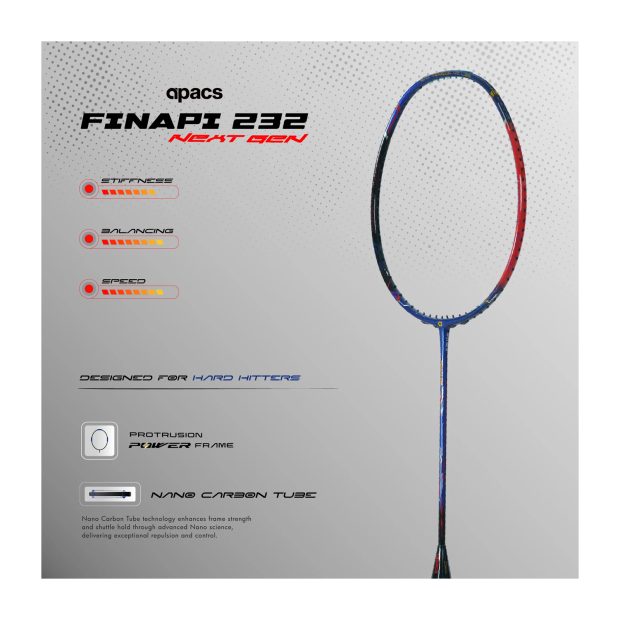
Apacs Finapi 232 is one of the most recognised budget-to-mid-range badminton rackets ever produced — a racket that introduced millions of Indian players to Apacs as a brand, and established the Finapi 232 identity: even balance, aero-wide frame, accessible medium flex, and industry-leading string tension capacity. The Apacs Finapi 232 Next Gen Badminton Racket is Apacs’ 2024 answer to the question of what comes after a legend.
₹6,999.00 Original price was: ₹6,999.00.₹2,543.00Current price is: ₹2,543.00.
Estimated Delivery Time: 2 - 4 Days (Delivery subject to pincode)
Estimated Delivery Time: 2 - 4 Days (Delivery subject to pincode)
Watch this video before Buying

Frequently Bought Together
Specification
Description
FAQ's
Specification
Description
God of Sports Expert Verdict on Apacs Finapi 232 Next Gen Badminton Racket:
The Finapi 232 Next Gen’s central upgrade — UHM (Ultra High Modulus) Japanese Graphite — is a meaningful material improvement over the 24T High Modulus graphite in the original. UHM graphite has a higher carbon fibre modulus (stiffness-per-weight ratio) than standard HM: this means the frame is structurally more rigid at the same weight, producing better energy transfer per unit of swing force, reduced frame deformation under impact loading, and improved long-term structural integrity under repeated high-tension stringing. For a frame that is being pushed to 40 lbs of string tension — significantly more than the 24–28 lbs most intermediate players use — this structural improvement is genuinely important: UHM frames handle high tension cycling more reliably than standard HM over the long term.
The 40 lbs maximum is the Next Gen’s other headline number. The original Finapi 232’s 38 lbs was already exceptionally high for a mid-range racket — and the 232 Next Gen takes it further. For most recreational and club-level players, this number is academic: you’ll string between 24 and 28 lbs, well inside both limits. But for advancing players who string tighter (28–32 lbs) for more direct control, and especially for aspiring high-tension users who want to eventually explore 32+ lbs, the Next Gen’s higher ceiling is a practical advantage that delays the point at which the racket becomes a limiting factor in your stringing choices.
The even balance at ~290mm is a deliberate, considered choice. Many attacking rackets in this price bracket are head-heavy — they produce better smash power but at the cost of net speed and transition agility. The Finapi 232 Next Gen’s even balance means that rear-court power, mid-court drives, and net play all feel equally natural. It is the right choice for players who play all-court badminton rather than specialists who smash from deep.
At its price point, the Finapi 232 Next Gen is one of the most materially serious all-round rackets available from Apacs. The UHM upgrade is not a marketing label — it is a genuine move up the material quality ladder from the original, delivered without a proportional jump in price.
Technologies used in Apacs Finapi 232 Next Gen Badminton Racket:
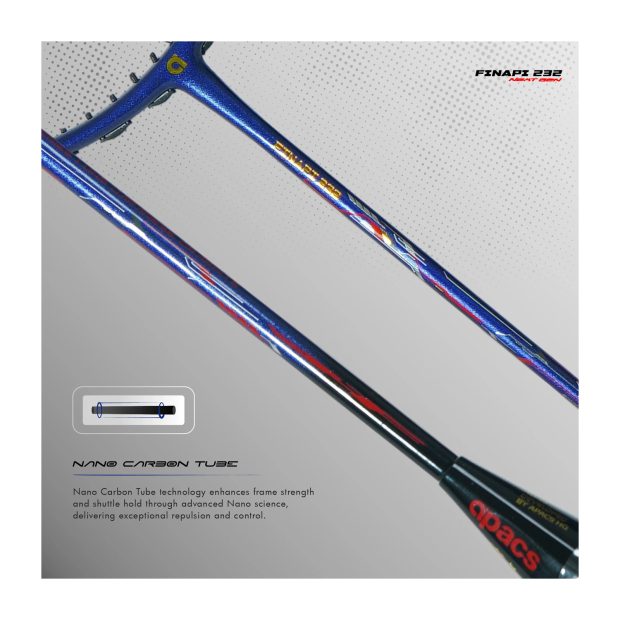
- UHM (Ultra High Modulus) Japanese Graphite — The Material Upgrade That Matters : The Apacs Finapi 232 Next Gen Badminton Racket most significant upgrade over its predecessor is the frame material: UHM, or Ultra High Modulus Japanese Graphite, replaces the standard 24T High Modulus graphite used in the original Finapi 232. “Modulus” in carbon fibre engineering refers to the material’s stiffness-to-weight ratio — specifically, how much the fibre resists deformation per unit of cross-sectional area when a load is applied. Ultra High Modulus carbon has a higher modulus rating than standard High Modulus: the fibres are stiffer per unit of weight, meaning the same amount of graphite material produces a more rigid, energy-efficient structure. In a badminton racket frame, this produces three practical benefits: better energy transfer from your swing to the shuttle (less energy lost to micro-deformation of the frame), greater structural resistance under repeated high-tension stringing (the frame maintains its geometry more reliably across hundreds of stringing cycles), and a more responsive, direct feel on impact that advanced players associate with higher-end frames.
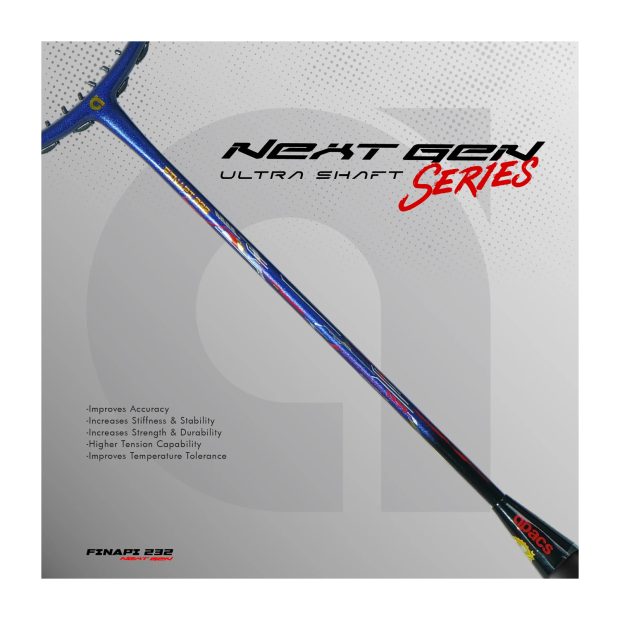
- 7.5mm Taper Shaft — Aerodynamic Reach in Medium Flex : The Apacs Finapi 232 Next Gen Badminton Racket uses a 7.5mm taper shaft — a slightly wider-diameter shaft than the ultra-slim 6.4–6.8mm shafts found on specialist attacking or premium rackets. The taper design means the shaft is not a uniform cylinder but is slightly wider at the T-joint end and tapers toward the grip, a construction that concentrates more material at the structural stress point (where shaft meets frame) while keeping the mid-shaft section aerodynamically competitive. The 7.5mm diameter places this shaft in the comfortable, forgiving range: it is more elastic than ultra-slim shafts, stores energy broadly across a range of swing tempos, and is particularly forgiving on mishits, producing more consistent shuttle speed even when contact timing is imperfect. The medium flex rating (8.5 on Apacs’ scale) provides a noticeable “kick” on impact — the shaft bends on the downswing, stores energy, and snaps back through contact — a property that beginning and intermediate players experience as effortless power generation even from less-than-full swings.
- Aero Wide Frame — Larger Head Profile for Sweet Spot and Smash Power : Apacs Finapi 232 Next Gen Badminton Racket inherits the original Finapi 232’s defining frame geometry: the Aero Wide head. Unlike the compact, smaller frames used in head-heavy specialist attacking rackets (like the Z Ziggler family), the Aero Wide head is a deliberately larger frame profile. The wider frame head produces two performance effects: first, a larger string bed area that extends the effective sweet spot — more of the frame is productive on contact, reducing the penalty for off-centre hits. Second, the wider frame cross-section increases the moment of inertia (rotational resistance) of the frame head, which produces more smash power on full swings by increasing the effective mass concentration at the periphery of the head. This is the aerodynamic paradox at the heart of the Finapi 232 design: a wider frame creates slightly more air resistance during the swing but delivers more energy at contact. At medium flex and medium swing tempos, the trade-off is net positive for most all-round players.
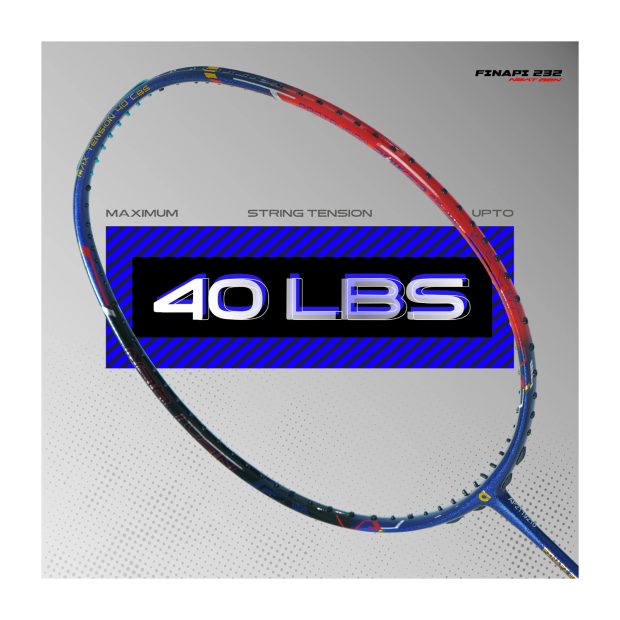
- 40 LBS Maximum Tension — The Highest in the Mid-Range Apacs Class : The original Finapi 232 was already known for its 38 lbs maximum tension — a specification that set it apart from many contemporaries in its price bracket. The Next Gen pushes this to 40 lbs, matching the Finapi 232 Xtra Power’s tension capacity and sitting above the standard 38 lbs of most competing mid-range options. Higher maximum tension capacity is primarily a structural claim: it means the frame’s graphite construction, grommet system, and resin bonding can withstand the compressive forces of 40 lbs of string tension without risk of frame damage or grommet failure. The 76-hole grommet system plays a direct role here — more grommets mean each individual grommet absorbs less tension load, distributing stress more evenly across the frame. Most players will string between 24–28 lbs; but for advancing players who prefer tighter strings (28–32 lbs) for crisper shuttle control and reduced trampoline effect, and for players who want to experiment with even higher tensions, the 40 lbs ceiling provides genuine headroom.
- Even Balance (~290mm) — The All-Rounder Philosophy : Apacs Finapi 232 Next Gen Badminton Racket ~290mm even balance is its most important design decision for defining playing character. This balance point sits in neither the head-heavy nor head-light category: it produces a racket that feels neutral in the hand, transfers smoothly between forehand and backhand transitions without the additional inertia of a head-heavy frame, and provides consistent performance from any area of the court. Even-balance rackets are the choice of players who value versatility over specialisation — particularly all-court players who move fluidly from rear-court smashing to net play to mid-court drives within a single rally. Players who play predominantly singles with an all-court style, or doubles players who occupy multiple court positions, benefit disproportionately from this balance compared to players who dominate from a fixed rear-court position where a head-heavy frame would add more value.
Finapi 232 Apacs Badminton Racket Family — Choosing the Right Generation:
| Model | Material | Balance | Max Tension | Key Character |
|---|---|---|---|---|
| Finapi 232 (Original) | 24T Japan HM Graphite | Even (~285±3mm) | 38 lbs | The classic all-rounder — proven, affordable entry point |
| Finapi 232 Next Gen | UHM Japan Graphite (30T/24T) | Even (~290±3mm) | 40 lbs | Material upgrade: stiffer, more energy-efficient, higher tension |
| Finapi 232 Xtra Power | UHM Japan Graphite | Even balance | 40 lbs | Power-biased tuning within the same frame family |
| Finapi 232 Reborn | UHM Japan Graphite | Head-heavy (~285±3mm) | 42 lbs | Power specialist — maximum tension, head-heavy for attacking play |
Is Apacs Finapi 232 Next Gen Badminton Racket Right for You?
- All-Court Players Who Want a Versatile Racket They Can Grow Into : The Finapi 232 Next Gen’s even balance and medium flex make it genuinely excellent for players who cover the full court — moving from smashes to net kills to mid-court drives within a single rally. The even balance means no area of the court feels disadvantaged by your racket’s weight distribution. The UHM graphite and 40 lbs tension ceiling mean the frame will accommodate your development as a player, remaining relevant as your technique improves and your stringing preferences tighten.
- Players Upgrading From the Original Finapi 232 Who Want Better Materials : If you have played with and enjoyed the original Finapi 232 — its balance, its feel, its playing character — the Next Gen is the straightforward material upgrade within the same design family. You get UHM graphite instead of standard HM, 40 lbs instead of 38 lbs, and a slightly updated shaft profile, in a package that preserves the even-balance, all-round character of the original. No adjustment period; just a better-built version of what you already play with.
- Intermediate Players Who Want to String High for Better Control : The 40 lbs maximum tension is a genuine practical advantage for players who prefer tight strings (28–35 lbs) for crisper shuttle feedback and more direct control. Many mid-range rackets are limited to 30–32 lbs at this price point. The Next Gen’s UHM frame comfortably accommodates higher tension stringing for players who want to experiment with tighter setups without worrying about frame integrity.
FAQ's
Shop Online
Shop 24/7 with your smartphone
Shipping Worldwide
Free Shipping All Over India
Pay on Delivery
You're in safe hands
Frequently Bought Together
Product Details
Specification
Description
FAQ's
Specification
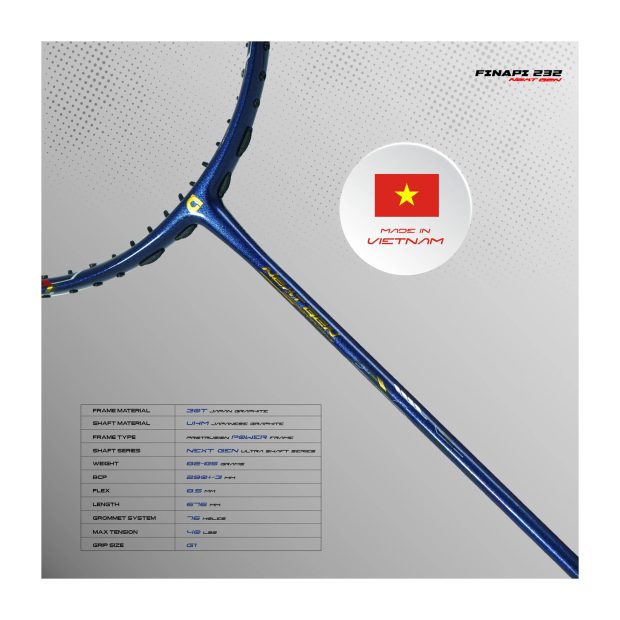
| Weight | 4U (80–83g) |
| Grip Size | G1 |
| Balance Point | Even Balance (~290±3mm) |
| Shaft Diameter | 7.5mm Taper Shaft (Ultra Slim) |
| Shaft Flex | Medium (Flex Rating 8.5) |
| Frame Material | 30 Tonne Japan Graphite (UHM) |
| Shaft Material | 24 Tonne Japan Graphite |
| Frame Type | Aero Wide |
| Grommet System | 76 Holes |
| Max String Tension | 40 lbs (18.1kg) |
| Overall Length | 675mm |
| Made In | Vietnam |
| Play Style | All-Round (Versatile) |
Description
God of Sports Expert Verdict on Apacs Finapi 232 Next Gen Badminton Racket:
The Finapi 232 Next Gen’s central upgrade — UHM (Ultra High Modulus) Japanese Graphite — is a meaningful material improvement over the 24T High Modulus graphite in the original. UHM graphite has a higher carbon fibre modulus (stiffness-per-weight ratio) than standard HM: this means the frame is structurally more rigid at the same weight, producing better energy transfer per unit of swing force, reduced frame deformation under impact loading, and improved long-term structural integrity under repeated high-tension stringing. For a frame that is being pushed to 40 lbs of string tension — significantly more than the 24–28 lbs most intermediate players use — this structural improvement is genuinely important: UHM frames handle high tension cycling more reliably than standard HM over the long term.
The 40 lbs maximum is the Next Gen’s other headline number. The original Finapi 232’s 38 lbs was already exceptionally high for a mid-range racket — and the 232 Next Gen takes it further. For most recreational and club-level players, this number is academic: you’ll string between 24 and 28 lbs, well inside both limits. But for advancing players who string tighter (28–32 lbs) for more direct control, and especially for aspiring high-tension users who want to eventually explore 32+ lbs, the Next Gen’s higher ceiling is a practical advantage that delays the point at which the racket becomes a limiting factor in your stringing choices.
The even balance at ~290mm is a deliberate, considered choice. Many attacking rackets in this price bracket are head-heavy — they produce better smash power but at the cost of net speed and transition agility. The Finapi 232 Next Gen’s even balance means that rear-court power, mid-court drives, and net play all feel equally natural. It is the right choice for players who play all-court badminton rather than specialists who smash from deep.
At its price point, the Finapi 232 Next Gen is one of the most materially serious all-round rackets available from Apacs. The UHM upgrade is not a marketing label — it is a genuine move up the material quality ladder from the original, delivered without a proportional jump in price.
Technologies used in Apacs Finapi 232 Next Gen Badminton Racket:
- UHM (Ultra High Modulus) Japanese Graphite — The Material Upgrade That Matters : The Apacs Finapi 232 Next Gen Badminton Racket most significant upgrade over its predecessor is the frame material: UHM, or Ultra High Modulus Japanese Graphite, replaces the standard 24T High Modulus graphite used in the original Finapi 232. “Modulus” in carbon fibre engineering refers to the material’s stiffness-to-weight ratio — specifically, how much the fibre resists deformation per unit of cross-sectional area when a load is applied. Ultra High Modulus carbon has a higher modulus rating than standard High Modulus: the fibres are stiffer per unit of weight, meaning the same amount of graphite material produces a more rigid, energy-efficient structure. In a badminton racket frame, this produces three practical benefits: better energy transfer from your swing to the shuttle (less energy lost to micro-deformation of the frame), greater structural resistance under repeated high-tension stringing (the frame maintains its geometry more reliably across hundreds of stringing cycles), and a more responsive, direct feel on impact that advanced players associate with higher-end frames.
- 7.5mm Taper Shaft — Aerodynamic Reach in Medium Flex : The Apacs Finapi 232 Next Gen Badminton Racket uses a 7.5mm taper shaft — a slightly wider-diameter shaft than the ultra-slim 6.4–6.8mm shafts found on specialist attacking or premium rackets. The taper design means the shaft is not a uniform cylinder but is slightly wider at the T-joint end and tapers toward the grip, a construction that concentrates more material at the structural stress point (where shaft meets frame) while keeping the mid-shaft section aerodynamically competitive. The 7.5mm diameter places this shaft in the comfortable, forgiving range: it is more elastic than ultra-slim shafts, stores energy broadly across a range of swing tempos, and is particularly forgiving on mishits, producing more consistent shuttle speed even when contact timing is imperfect. The medium flex rating (8.5 on Apacs’ scale) provides a noticeable “kick” on impact — the shaft bends on the downswing, stores energy, and snaps back through contact — a property that beginning and intermediate players experience as effortless power generation even from less-than-full swings.
- Aero Wide Frame — Larger Head Profile for Sweet Spot and Smash Power : Apacs Finapi 232 Next Gen Badminton Racket inherits the original Finapi 232’s defining frame geometry: the Aero Wide head. Unlike the compact, smaller frames used in head-heavy specialist attacking rackets (like the Z Ziggler family), the Aero Wide head is a deliberately larger frame profile. The wider frame head produces two performance effects: first, a larger string bed area that extends the effective sweet spot — more of the frame is productive on contact, reducing the penalty for off-centre hits. Second, the wider frame cross-section increases the moment of inertia (rotational resistance) of the frame head, which produces more smash power on full swings by increasing the effective mass concentration at the periphery of the head. This is the aerodynamic paradox at the heart of the Finapi 232 design: a wider frame creates slightly more air resistance during the swing but delivers more energy at contact. At medium flex and medium swing tempos, the trade-off is net positive for most all-round players.
- 40 LBS Maximum Tension — The Highest in the Mid-Range Apacs Class : The original Finapi 232 was already known for its 38 lbs maximum tension — a specification that set it apart from many contemporaries in its price bracket. The Next Gen pushes this to 40 lbs, matching the Finapi 232 Xtra Power’s tension capacity and sitting above the standard 38 lbs of most competing mid-range options. Higher maximum tension capacity is primarily a structural claim: it means the frame’s graphite construction, grommet system, and resin bonding can withstand the compressive forces of 40 lbs of string tension without risk of frame damage or grommet failure. The 76-hole grommet system plays a direct role here — more grommets mean each individual grommet absorbs less tension load, distributing stress more evenly across the frame. Most players will string between 24–28 lbs; but for advancing players who prefer tighter strings (28–32 lbs) for crisper shuttle control and reduced trampoline effect, and for players who want to experiment with even higher tensions, the 40 lbs ceiling provides genuine headroom.
- Even Balance (~290mm) — The All-Rounder Philosophy : Apacs Finapi 232 Next Gen Badminton Racket ~290mm even balance is its most important design decision for defining playing character. This balance point sits in neither the head-heavy nor head-light category: it produces a racket that feels neutral in the hand, transfers smoothly between forehand and backhand transitions without the additional inertia of a head-heavy frame, and provides consistent performance from any area of the court. Even-balance rackets are the choice of players who value versatility over specialisation — particularly all-court players who move fluidly from rear-court smashing to net play to mid-court drives within a single rally. Players who play predominantly singles with an all-court style, or doubles players who occupy multiple court positions, benefit disproportionately from this balance compared to players who dominate from a fixed rear-court position where a head-heavy frame would add more value.
Finapi 232 Apacs Badminton Racket Family — Choosing the Right Generation:
| Model | Material | Balance | Max Tension | Key Character |
|---|---|---|---|---|
| Finapi 232 (Original) | 24T Japan HM Graphite | Even (~285±3mm) | 38 lbs | The classic all-rounder — proven, affordable entry point |
| Finapi 232 Next Gen | UHM Japan Graphite (30T/24T) | Even (~290±3mm) | 40 lbs | Material upgrade: stiffer, more energy-efficient, higher tension |
| Finapi 232 Xtra Power | UHM Japan Graphite | Even balance | 40 lbs | Power-biased tuning within the same frame family |
| Finapi 232 Reborn | UHM Japan Graphite | Head-heavy (~285±3mm) | 42 lbs | Power specialist — maximum tension, head-heavy for attacking play |
Is Apacs Finapi 232 Next Gen Badminton Racket Right for You?
- All-Court Players Who Want a Versatile Racket They Can Grow Into : The Finapi 232 Next Gen’s even balance and medium flex make it genuinely excellent for players who cover the full court — moving from smashes to net kills to mid-court drives within a single rally. The even balance means no area of the court feels disadvantaged by your racket’s weight distribution. The UHM graphite and 40 lbs tension ceiling mean the frame will accommodate your development as a player, remaining relevant as your technique improves and your stringing preferences tighten.
- Players Upgrading From the Original Finapi 232 Who Want Better Materials : If you have played with and enjoyed the original Finapi 232 — its balance, its feel, its playing character — the Next Gen is the straightforward material upgrade within the same design family. You get UHM graphite instead of standard HM, 40 lbs instead of 38 lbs, and a slightly updated shaft profile, in a package that preserves the even-balance, all-round character of the original. No adjustment period; just a better-built version of what you already play with.
- Intermediate Players Who Want to String High for Better Control : The 40 lbs maximum tension is a genuine practical advantage for players who prefer tight strings (28–35 lbs) for crisper shuttle feedback and more direct control. Many mid-range rackets are limited to 30–32 lbs at this price point. The Next Gen’s UHM frame comfortably accommodates higher tension stringing for players who want to experiment with tighter setups without worrying about frame integrity.
FAQ's
| Weight | 4U (80–83g) |
| Grip Size | G1 |
| Balance Point | Even Balance (~290±3mm) |
| Shaft Diameter | 7.5mm Taper Shaft (Ultra Slim) |
| Shaft Flex | Medium (Flex Rating 8.5) |
| Frame Material | 30 Tonne Japan Graphite (UHM) |
| Shaft Material | 24 Tonne Japan Graphite |
| Frame Type | Aero Wide |
| Grommet System | 76 Holes |
| Max String Tension | 40 lbs (18.1kg) |
| Overall Length | 675mm |
| Made In | Vietnam |
| Play Style | All-Round (Versatile) |
God of Sports Expert Verdict on Apacs Finapi 232 Next Gen Badminton Racket:
The Finapi 232 Next Gen’s central upgrade — UHM (Ultra High Modulus) Japanese Graphite — is a meaningful material improvement over the 24T High Modulus graphite in the original. UHM graphite has a higher carbon fibre modulus (stiffness-per-weight ratio) than standard HM: this means the frame is structurally more rigid at the same weight, producing better energy transfer per unit of swing force, reduced frame deformation under impact loading, and improved long-term structural integrity under repeated high-tension stringing. For a frame that is being pushed to 40 lbs of string tension — significantly more than the 24–28 lbs most intermediate players use — this structural improvement is genuinely important: UHM frames handle high tension cycling more reliably than standard HM over the long term.
The 40 lbs maximum is the Next Gen’s other headline number. The original Finapi 232’s 38 lbs was already exceptionally high for a mid-range racket — and the 232 Next Gen takes it further. For most recreational and club-level players, this number is academic: you’ll string between 24 and 28 lbs, well inside both limits. But for advancing players who string tighter (28–32 lbs) for more direct control, and especially for aspiring high-tension users who want to eventually explore 32+ lbs, the Next Gen’s higher ceiling is a practical advantage that delays the point at which the racket becomes a limiting factor in your stringing choices.
The even balance at ~290mm is a deliberate, considered choice. Many attacking rackets in this price bracket are head-heavy — they produce better smash power but at the cost of net speed and transition agility. The Finapi 232 Next Gen’s even balance means that rear-court power, mid-court drives, and net play all feel equally natural. It is the right choice for players who play all-court badminton rather than specialists who smash from deep.
At its price point, the Finapi 232 Next Gen is one of the most materially serious all-round rackets available from Apacs. The UHM upgrade is not a marketing label — it is a genuine move up the material quality ladder from the original, delivered without a proportional jump in price.
Technologies used in Apacs Finapi 232 Next Gen Badminton Racket:
- UHM (Ultra High Modulus) Japanese Graphite — The Material Upgrade That Matters : The Apacs Finapi 232 Next Gen Badminton Racket most significant upgrade over its predecessor is the frame material: UHM, or Ultra High Modulus Japanese Graphite, replaces the standard 24T High Modulus graphite used in the original Finapi 232. “Modulus” in carbon fibre engineering refers to the material’s stiffness-to-weight ratio — specifically, how much the fibre resists deformation per unit of cross-sectional area when a load is applied. Ultra High Modulus carbon has a higher modulus rating than standard High Modulus: the fibres are stiffer per unit of weight, meaning the same amount of graphite material produces a more rigid, energy-efficient structure. In a badminton racket frame, this produces three practical benefits: better energy transfer from your swing to the shuttle (less energy lost to micro-deformation of the frame), greater structural resistance under repeated high-tension stringing (the frame maintains its geometry more reliably across hundreds of stringing cycles), and a more responsive, direct feel on impact that advanced players associate with higher-end frames.
- 7.5mm Taper Shaft — Aerodynamic Reach in Medium Flex : The Apacs Finapi 232 Next Gen Badminton Racket uses a 7.5mm taper shaft — a slightly wider-diameter shaft than the ultra-slim 6.4–6.8mm shafts found on specialist attacking or premium rackets. The taper design means the shaft is not a uniform cylinder but is slightly wider at the T-joint end and tapers toward the grip, a construction that concentrates more material at the structural stress point (where shaft meets frame) while keeping the mid-shaft section aerodynamically competitive. The 7.5mm diameter places this shaft in the comfortable, forgiving range: it is more elastic than ultra-slim shafts, stores energy broadly across a range of swing tempos, and is particularly forgiving on mishits, producing more consistent shuttle speed even when contact timing is imperfect. The medium flex rating (8.5 on Apacs’ scale) provides a noticeable “kick” on impact — the shaft bends on the downswing, stores energy, and snaps back through contact — a property that beginning and intermediate players experience as effortless power generation even from less-than-full swings.
- Aero Wide Frame — Larger Head Profile for Sweet Spot and Smash Power : Apacs Finapi 232 Next Gen Badminton Racket inherits the original Finapi 232’s defining frame geometry: the Aero Wide head. Unlike the compact, smaller frames used in head-heavy specialist attacking rackets (like the Z Ziggler family), the Aero Wide head is a deliberately larger frame profile. The wider frame head produces two performance effects: first, a larger string bed area that extends the effective sweet spot — more of the frame is productive on contact, reducing the penalty for off-centre hits. Second, the wider frame cross-section increases the moment of inertia (rotational resistance) of the frame head, which produces more smash power on full swings by increasing the effective mass concentration at the periphery of the head. This is the aerodynamic paradox at the heart of the Finapi 232 design: a wider frame creates slightly more air resistance during the swing but delivers more energy at contact. At medium flex and medium swing tempos, the trade-off is net positive for most all-round players.
- 40 LBS Maximum Tension — The Highest in the Mid-Range Apacs Class : The original Finapi 232 was already known for its 38 lbs maximum tension — a specification that set it apart from many contemporaries in its price bracket. The Next Gen pushes this to 40 lbs, matching the Finapi 232 Xtra Power’s tension capacity and sitting above the standard 38 lbs of most competing mid-range options. Higher maximum tension capacity is primarily a structural claim: it means the frame’s graphite construction, grommet system, and resin bonding can withstand the compressive forces of 40 lbs of string tension without risk of frame damage or grommet failure. The 76-hole grommet system plays a direct role here — more grommets mean each individual grommet absorbs less tension load, distributing stress more evenly across the frame. Most players will string between 24–28 lbs; but for advancing players who prefer tighter strings (28–32 lbs) for crisper shuttle control and reduced trampoline effect, and for players who want to experiment with even higher tensions, the 40 lbs ceiling provides genuine headroom.
- Even Balance (~290mm) — The All-Rounder Philosophy : Apacs Finapi 232 Next Gen Badminton Racket ~290mm even balance is its most important design decision for defining playing character. This balance point sits in neither the head-heavy nor head-light category: it produces a racket that feels neutral in the hand, transfers smoothly between forehand and backhand transitions without the additional inertia of a head-heavy frame, and provides consistent performance from any area of the court. Even-balance rackets are the choice of players who value versatility over specialisation — particularly all-court players who move fluidly from rear-court smashing to net play to mid-court drives within a single rally. Players who play predominantly singles with an all-court style, or doubles players who occupy multiple court positions, benefit disproportionately from this balance compared to players who dominate from a fixed rear-court position where a head-heavy frame would add more value.
Finapi 232 Apacs Badminton Racket Family — Choosing the Right Generation:
| Model | Material | Balance | Max Tension | Key Character |
|---|---|---|---|---|
| Finapi 232 (Original) | 24T Japan HM Graphite | Even (~285±3mm) | 38 lbs | The classic all-rounder — proven, affordable entry point |
| Finapi 232 Next Gen | UHM Japan Graphite (30T/24T) | Even (~290±3mm) | 40 lbs | Material upgrade: stiffer, more energy-efficient, higher tension |
| Finapi 232 Xtra Power | UHM Japan Graphite | Even balance | 40 lbs | Power-biased tuning within the same frame family |
| Finapi 232 Reborn | UHM Japan Graphite | Head-heavy (~285±3mm) | 42 lbs | Power specialist — maximum tension, head-heavy for attacking play |
Is Apacs Finapi 232 Next Gen Badminton Racket Right for You?
- All-Court Players Who Want a Versatile Racket They Can Grow Into : The Finapi 232 Next Gen’s even balance and medium flex make it genuinely excellent for players who cover the full court — moving from smashes to net kills to mid-court drives within a single rally. The even balance means no area of the court feels disadvantaged by your racket’s weight distribution. The UHM graphite and 40 lbs tension ceiling mean the frame will accommodate your development as a player, remaining relevant as your technique improves and your stringing preferences tighten.
- Players Upgrading From the Original Finapi 232 Who Want Better Materials : If you have played with and enjoyed the original Finapi 232 — its balance, its feel, its playing character — the Next Gen is the straightforward material upgrade within the same design family. You get UHM graphite instead of standard HM, 40 lbs instead of 38 lbs, and a slightly updated shaft profile, in a package that preserves the even-balance, all-round character of the original. No adjustment period; just a better-built version of what you already play with.
- Intermediate Players Who Want to String High for Better Control : The 40 lbs maximum tension is a genuine practical advantage for players who prefer tight strings (28–35 lbs) for crisper shuttle feedback and more direct control. Many mid-range rackets are limited to 30–32 lbs at this price point. The Next Gen’s UHM frame comfortably accommodates higher tension stringing for players who want to experiment with tighter setups without worrying about frame integrity.
Customer Reviews
Products from same brand
JOOLA HC-40 Pickleballs (Pack of 50)
Joola Scorpeus Pro IV Pickleball Paddle (16mm)
JOOLA HC-40 Pickleballs (Pack of 3)
Similar Products
Yonex HY Ultra Badminton Shoes (Lava Red/Night Shadow)
Li-Ning Windstorm 76 Badminton Racket
Katana Ghost Air Edition Badminton Racket
Katana Mutant M90 Gorilla Badminton Racket (White/Black)
YONEX Tokyo Ultima Badminton Shoes for Men (Posy Green/Bright Gold)
Li-Ning Tectonic 9 Unstrung Badminton Racket (3U/ 88 gms)
YONEX Arcsaber 7 Play Badminton Racket
Li-Ning Champ Badminton Feather Shuttlecock (Speed 76)
Victor Thruster RYUGA Metallic Badminton Racket
Recently Viewed
God's Advice
Best Badminton Racquet for Beginners in India 2026
By
Sports Analyst
March 24, 2026


Best Pickleball Balls in India 2026
By
Sports Analyst
February 27, 2026

How Padel Is Growing in India: A New Era of Racket Sports
By
Sports Analyst
January 9, 2026
Announcing GOS Open – Indore Edition: Everything You Need to Know
By
Sports Analyst
January 9, 2026
Local Tournaments & Why They Matter for India’s Padel Community
By
Sports Analyst
January 9, 2026