Why Trust This Guide?
God of Sports has been selling pickleball paddles across India since 2023. We’ve watched pickleball explode from a curiosity sport in a handful of clubs to courts opening across Mumbai, Pune, Bangalore, Delhi, and Hyderabad. We play the game ourselves — indoors and outdoors. We’ve hit with 14mm paddles and 16mm paddles and we know exactly what the difference feels like when you’re dinking at the kitchen line at 10pm and when you’re trying to put away an overhead on a windy rooftop court. This guide is the answer to our single most-asked customer question.
The Question We Answer 10 Times a Day
Real Story: Kavya from Bangalore — the most common pickleball conversation we have
Kavya messaged us on WhatsApp at 11:30pm on a Thursday. She’d been playing pickleball for three months at a club in Indiranagar and was ready to upgrade from a borrowed paddle. She’d narrowed it down to two JOOLA paddles — one 16mm, one 14mm. Almost identical in every other way. The price difference was small. She typed: ‘Everyone at my club has an opinion but they all contradict each other. Can you just tell me which one?’We asked her three questions: How often do you dink? Do you have any elbow sensitivity? Are you a power player or a control player? She answered in 90 seconds. We told her: 16mm. Definitively. She bought it. Two weeks later she messaged again: ‘My drop shots are actually landing in the kitchen now.’This guide is that 90-second conversation, expanded into everything you need to make the same call for your game.
Quick Answer — If You’re in a Hurry
Choose 16mm if: You’re a beginner or intermediate player, you value control and dinking, you have any arm or elbow sensitivity, or you play primarily recreational/social pickleball.
Choose 14mm if: You’re an attacking power player, you compete regularly, your game relies on aggressive drives and overheads, or you’ve played 12+ months and are specifically chasing more pop.
Not sure? Read the five questions in Section 2. They’ll tell you. Five minutes.
What the Thickness Number Actually Means
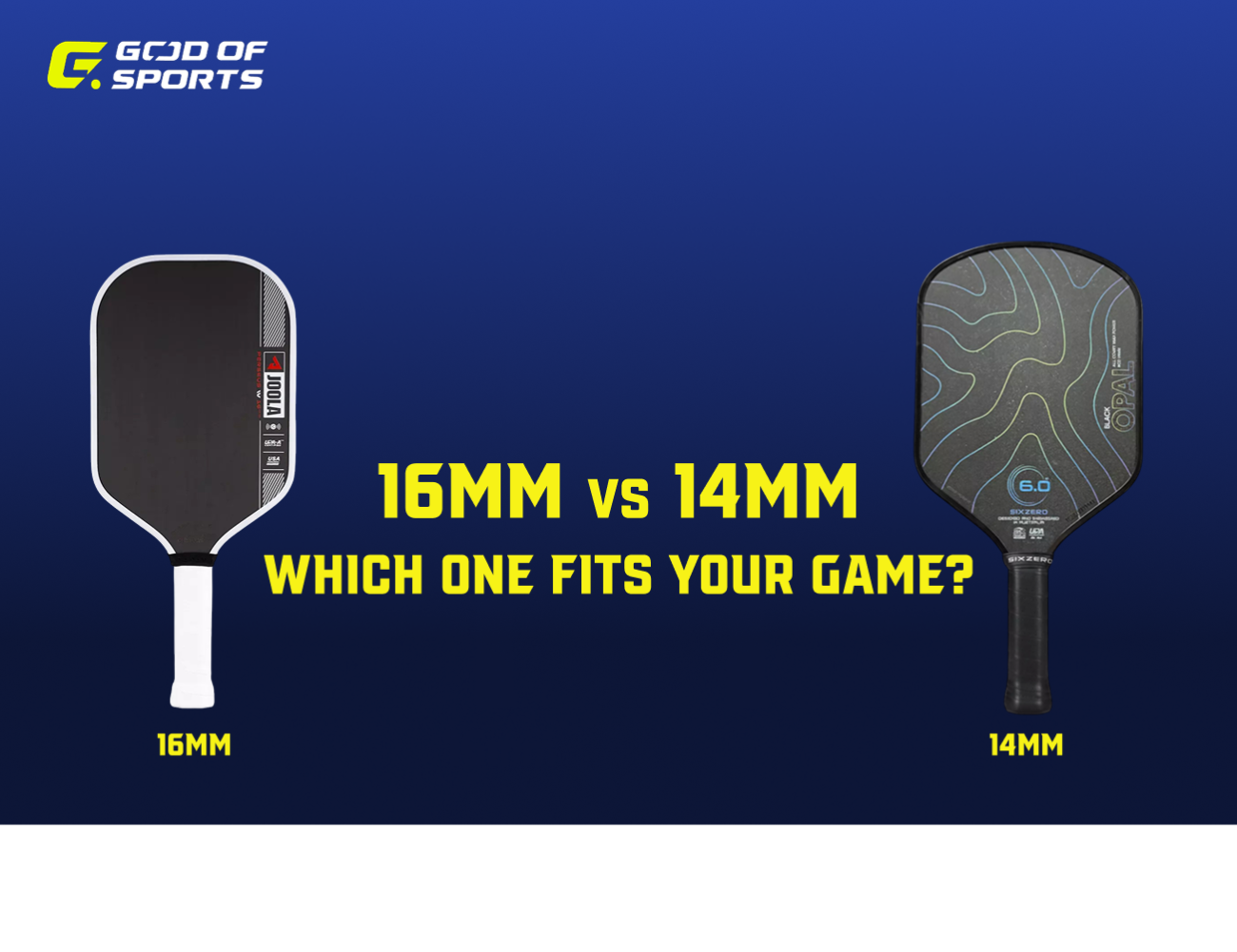
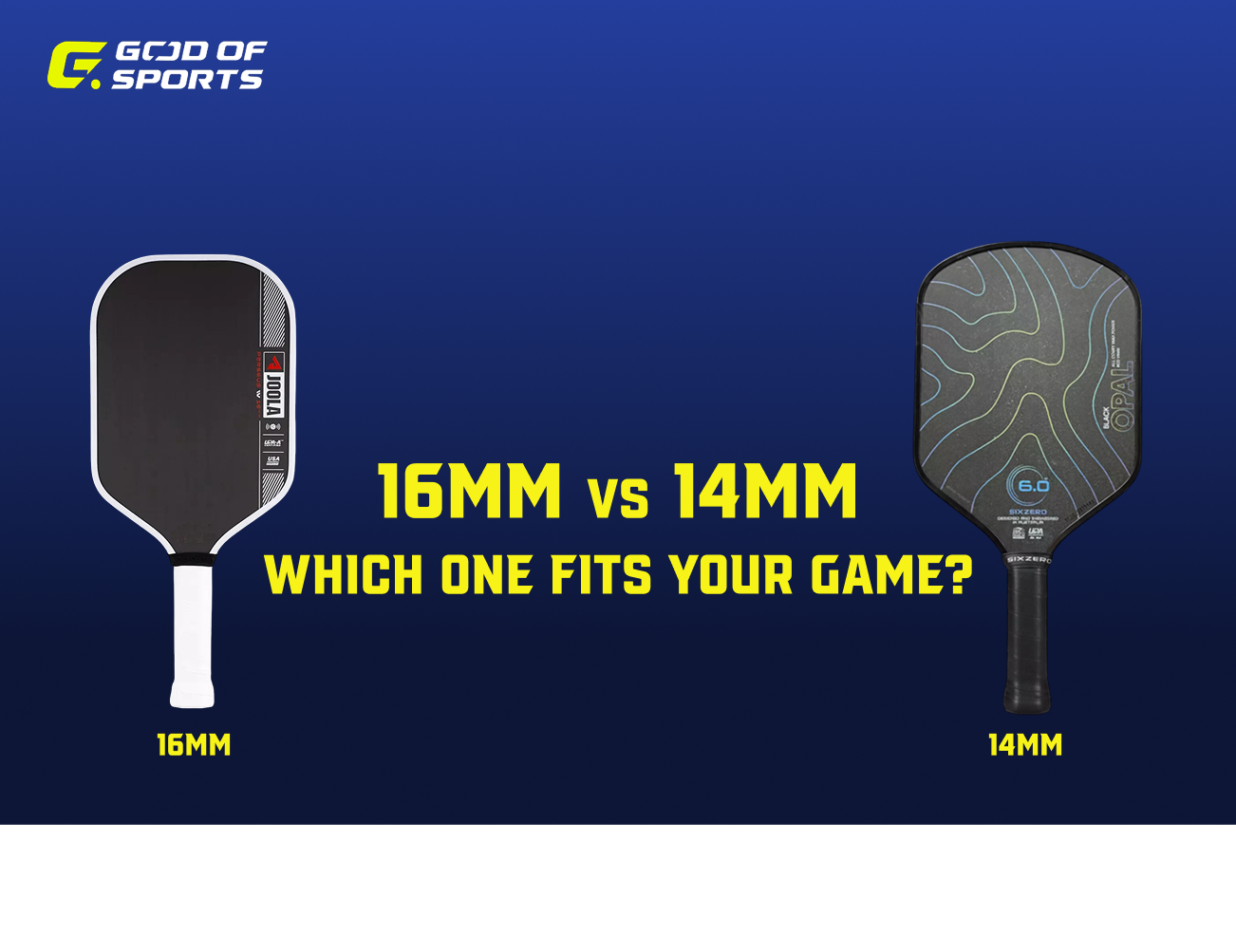
The core thickness — 14mm or 16mm — refers to the honeycomb polymer core inside the paddle. This is the foam-like structure between the two face surfaces. It’s what you hit through. Its thickness changes virtually everything about how the paddle feels and performs.
Here’s the counterintuitive part: thicker does not mean more power. The thicker core (16mm) creates more cushion — the ball has more material to compress against, creating longer dwell time (the ball stays on the paddle surface fractionally longer). This gives you more control over placement. The thinner core (14mm) is stiffer — the ball pops off faster and harder. More power, less touch.
Think of it like this: a 16mm paddle is the equivalent of a badminton player who wins through placement and angles. A 14mm paddle is the power smasher. Same sport. Completely different game philosophy.
The Full Breakdown — Head to Head
| Factor | 16mm Core | 14mm Core |
| Thickness | Thicker — more cushion | Thinner — more rigid |
| Pop / Power | Softer feel, controlled pop | Louder, harder pop, more power |
| Control | Higher — better at the kitchen | Lower — less dwell time |
| Dwell Time | Longer — ball stays on paddle longer | Shorter — quick release |
| Arm Comfort | Better — absorbs vibration | More vibration transmission |
| Speed | Slightly slower overall ball speed | Faster — aggressive drives |
| Best Style | Dinking, control, third-shot drops | Driving, attacking, power baseline |
| Ideal Player | Beginners, 3.5-4.0, smart play style | 3.5+ power players, competitors |
What ‘Dwell Time’ Actually Feels Like
Dwell time is how long the ball stays in contact with the paddle surface during a hit. It’s not something you consciously notice — but you feel its effects.
With a 16mm paddle, the ball compresses into the thicker core slightly longer. This gives your arm more time to direct the shot. On a dink — the soft, arcing shot that lands just over the net into the Non-Volley Zone (kitchen) — this longer contact time means more control. Your drop shots actually land where you aimed. Your resets are more reliable.
With a 14mm paddle, the contact is shorter and snappier. The ball leaves the paddle faster. For a hard drive or an overhead, this is exactly what you want — maximum energy transfer, maximum speed. For a delicate dink when you’re under pressure, it gives you less margin.
Real Story: The competitive player who switched back to 16mm
Rohan had been playing pickleball competitively for eight months in Delhi. He’d read that the pros use thinner paddles. He bought a 14mm and used it for three months. His drives improved noticeably. His third-shot drops fell apart. He was losing kitchen battles he used to win. He came back to us and asked what was happening. We asked him to film three rallies. Three of five had him hitting dinks into the net — no surprise with 14mm. He switched back to 16mm. ‘I thought thin was advanced,’ he told us. ‘I was wrong.’
The 5 Questions That Tell You Which to Buy
1. What rating do you play at?
3.0 and below: 16mm. No conversation needed.
3.5: 16mm as default, 14mm if you’re specifically a power-style player with consistent dinking.
4.0+: Either can work. Your style determines it.
2. How much of your game is dinking?
If you spend more than 30% of your rally time at the kitchen line, you want 16mm. Dinking with a 14mm paddle is like threading a needle with a power drill.
3. Do you have any arm or elbow sensitivity?
16mm. No debate. The extra core absorbs vibration that would otherwise travel up the paddle and into your wrist. We’ve had customers with mild tennis elbow caused by transitioning too early to 14mm. Don’t repeat that.
4. Do you play mostly indoors or outdoors?
Outdoors with wind: 16mm gives you better control in variable conditions. Wind messes with pop and placement — a 16mm paddle gives you more ability to compensate. Indoors in a controlled environment: either works well.
5. What does your best point look like?
Do you win by precision — outlasting your opponent through smart placement, resets, and kitchen battles? → 16mm.
Do you win by aggression — driving through opponents, winning with speed before they can respond? → 14mm.
Situation Guide: Who Wins What
| Playing Situation | 16mm Wins | 14mm Wins |
| Dinking at the kitchen line | ✅ | |
| Third-shot drop accuracy | ✅ | |
| Aggressive baseline drives | ✅ | |
| Volleying at the net | ✅ | |
| Outdoor play (wind conditions) | ✅ | |
| Overhead smashes | ✅ | |
| Arm or elbow sensitivity | ✅ | |
| Tournament aggressive play | ✅ | |
| Fun recreational games | ✅ |
Our Paddle Recommendations — By Thickness
16mm Paddles — Control, Touch, and Smart Play.
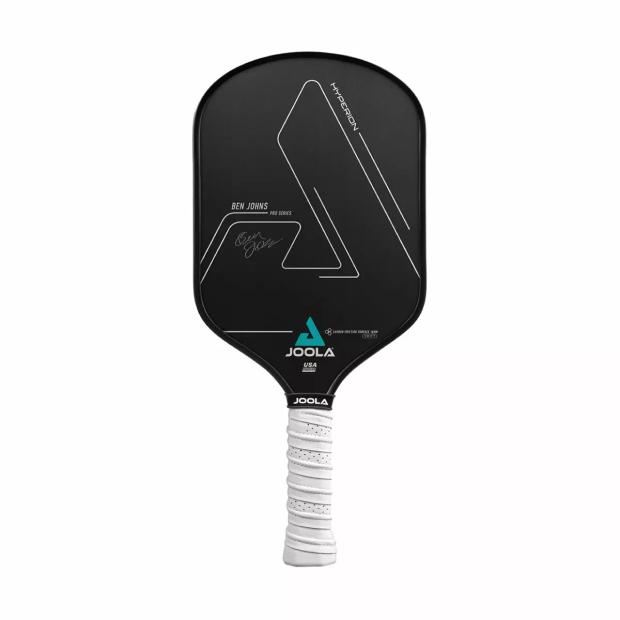
TOP PICK | 16mm JOOLA Ben JohnsPaddle Hyperion CFS 16 ~₹12,000–₹15,000
16mm Core | Carbon Fibre Surface | ~240g | Raw Carbon Face
The story: Ben Johns is the #1 ranked pickleball player in the world. The Hyperion is his paddle. Our most sophisticated 16mm customers — the ones who’ve done their research and come to us with specific questions about spin generation and dwell time — almost always land here. The raw carbon face creates texture that grips the ball for exceptional spin. At 16mm, it’s one of the most control-oriented paddles available without sacrificing touch. We’ve sold more of this paddle to players upgrading from beginner paddles than any other single SKU in our pickleball range.
Buy it if: You’ve been playing 6+ months, your game is developing, you care about dinking and control, and you’re ready to invest in something that will last 2+ years.
Skip it if: You’re a pure power attacker who wants maximum drive speed. Look at 14mm instead.
RUNNER-UP — 16mm JOOLA Solaire Pickleball Paddle ~₹8,000–₹11,000
16mm Core | Carbon/Fibreglass Face | ~235g | Balanced Weight
The story: The paddle we recommend most often to players who’ve been playing 3–6 months and want to upgrade without spending ₹15,000. The 16mm core gives the classic control benefits, and the weight balance is excellent for all-day recreational play. Multiple of our Mumbai and Pune customers play twice-weekly recreational games with this paddle and love it. The touch on dinks is precise and the arm feel is comfortable even after a 2-hour session.
Buy it if: You’ve been playing 3–6 months, play 2–3 times per week recreationally, and want control at a fair price.
Skip it if: You want maximum performance and are ready to spend more. The Hyperion is your next step.
14mm Paddles — Power, Pop, and Aggressive Play
TOP PICK — 14mm JOOLA Ben Johns Hyperion CFS 14 Paddle ~₹13,000–₹16,000
14mm Core | Carbon Fibre Surface | ~240g | Raw Carbon Face
The story: Same DNA as the 16mm version — but the thinner core changes the game entirely. On a drive, the pop is immediately noticeable. The ball leaves the paddle faster and harder than anything in the 16mm range. We have three competitive players in Bangalore who play in organised tournaments and all three use this paddle. One of them described it as ‘the difference between nudging a shot and launching it.’ That’s accurate. This is a weapon for a player who’s ready for it.
Buy it if: You compete regularly, your game is built on drives and aggression, and your technique is consistent enough that the reduced dwell time doesn’t hurt your dinking.
Skip it if: You’re still building your dinking game. 14mm will slow that progress. Start with 16mm.
Shop JOOLA Ben Johns 14mm →
The Myth of ‘Thinner = More Advanced
This misconception is everywhere in pickleball communities — the idea that serious players use 14mm paddles and beginners use 16mm. It’s not true, and it’s causing people to buy wrong.
Ben Johns himself — World No. 1 — has played with both thicknesses at different points in his career. His choice depended on the playing conditions and the opponents he expected to face. Many 4.5+ rated club players in India use 16mm paddles as their primary paddle because their game is built on kitchen dominance and smart placement.
Thickness is a playing-style decision, not a skill-level decision. A 3.5-rated player who controls the kitchen with a 16mm paddle will beat a 3.5-rated player who drives with a 14mm paddle in most recreational formats.
Expert Tip
If someone at your club tells you that 16mm is ‘for beginners,’ ask them their rating. Then ask them how often they win kitchen battles. The answer will tell you everything.
Frequently Asked Questions
Q: Can I tell the difference between 14mm and 16mm just by holding the paddle?
Experienced players can — the 16mm paddle feels slightly more cushioned on impact. Beginners often can’t tell the difference by feel, which is why the spec matters more than the feel test in a shop.
Q: Do professional players use 14mm or 16mm?
Both — depending on their playing style. Control-oriented pros prefer 16mm. Power attackers tend toward 14mm. The myth that all pros use 14mm is false.
Q: Will switching from 16mm to 14mm improve my game?
Only if you’re an established player whose game is limited by lack of power on drives, not by control. If your kitchen game needs work, switching to 14mm will make things worse, not better.
Q: Are there 13mm paddles? Should I consider them?
Some paddles use 13mm cores — even stiffer, even more power, even less control. We don’t recommend them for recreational play in India. They’re specialist paddles for very specific competitive play styles.
Q: What core material matters alongside the thickness?
Polymer honeycomb is the dominant and best core material for recreational and competitive play. Avoid paddles advertised as ‘composite foam’ at very low price points — the core degrades much faster. All JOOLA paddles we carry use quality polymer cores.
Q: I have tennis elbow — which should I choose?
16mm, without exception. The extra cushion absorbs the vibration that aggravates tennis elbow. Also look for paddles with vibration-dampening edge guards. If you have significant elbow pain, speak to a physiotherapist before continuing play.
Final Verdict
Real Story: What we tell our own team when they ask which to buy
When our own staff have asked which paddle to get for their personal game, we’ve given the same answer every time: start with 16mm. You can always move to 14mm once your kitchen game is solid and you know your attacking style. You can’t un-damage your elbow from buying 14mm before your technique was ready. The 16mm is the better starting point for 85% of pickleball players in India right now.
The GOS 30-Second Decision
I dink a lot, value control, and/or have any arm sensitivity → 16mm. JOOLA Hyperion CFS 16.
I attack aggressively, compete regularly, and my dinking is solid → 14mm. JOOLA Hyperion CFS 14.
I don’t know yet → 16mm. Come back in 6 months when you know your game better.