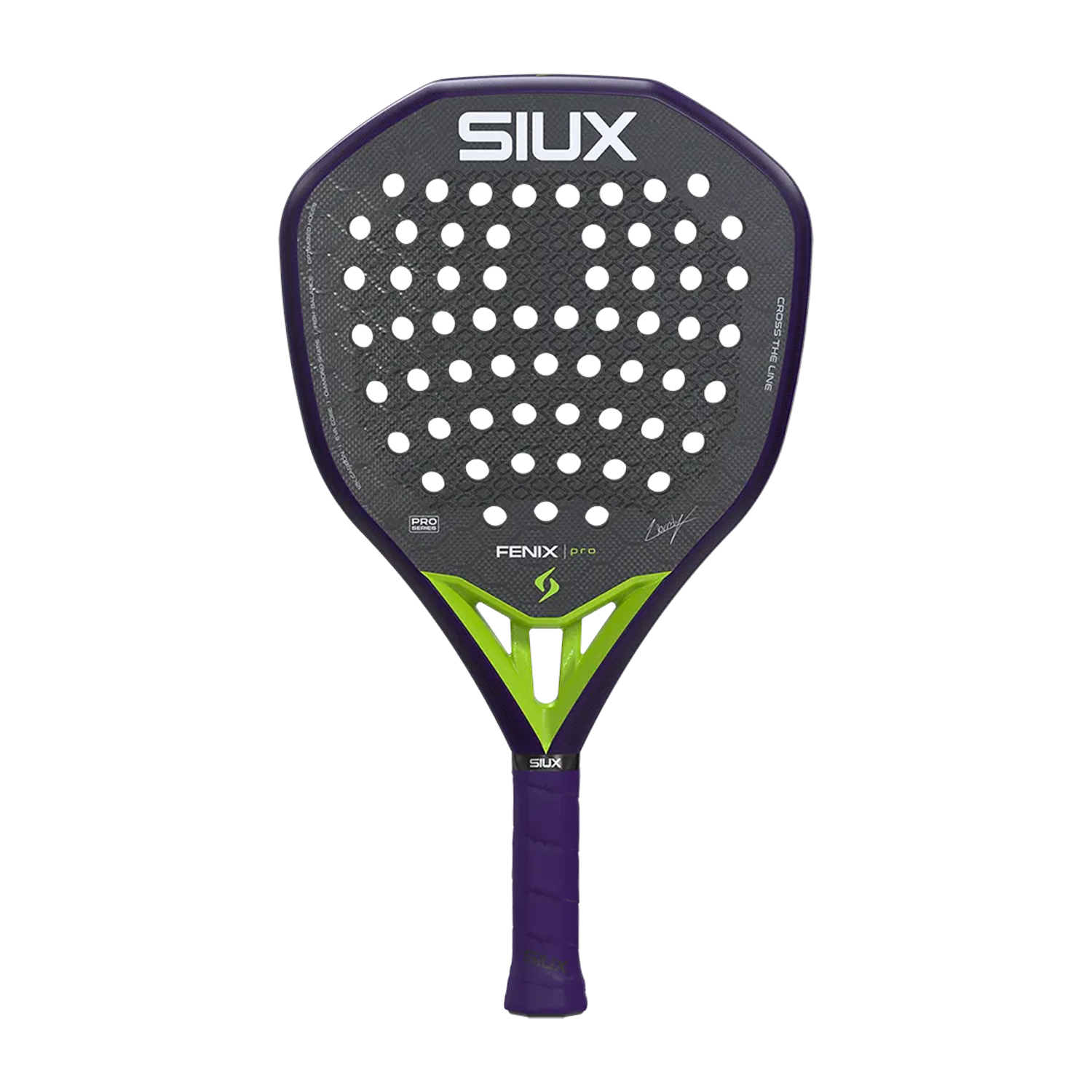







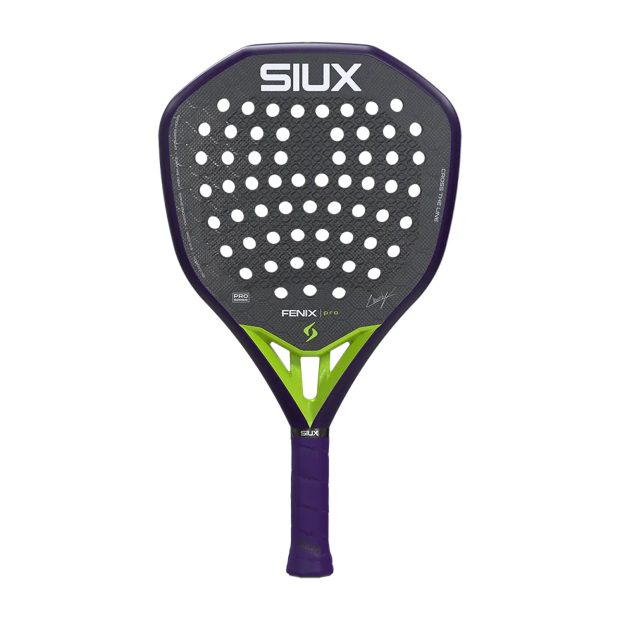
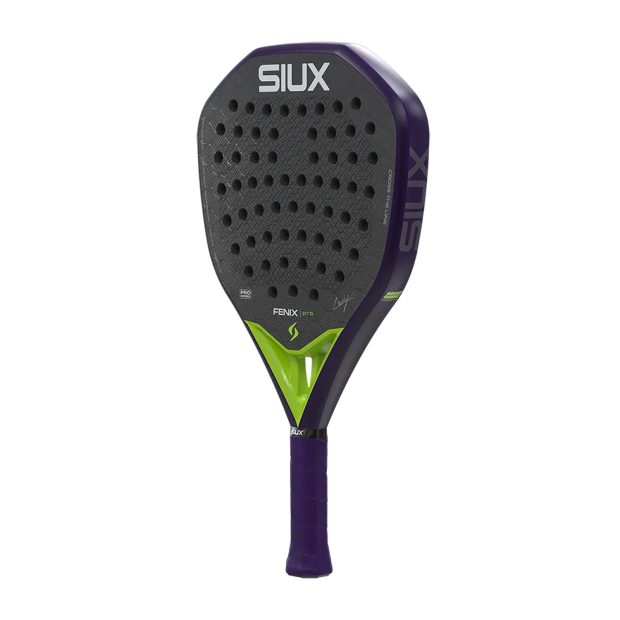
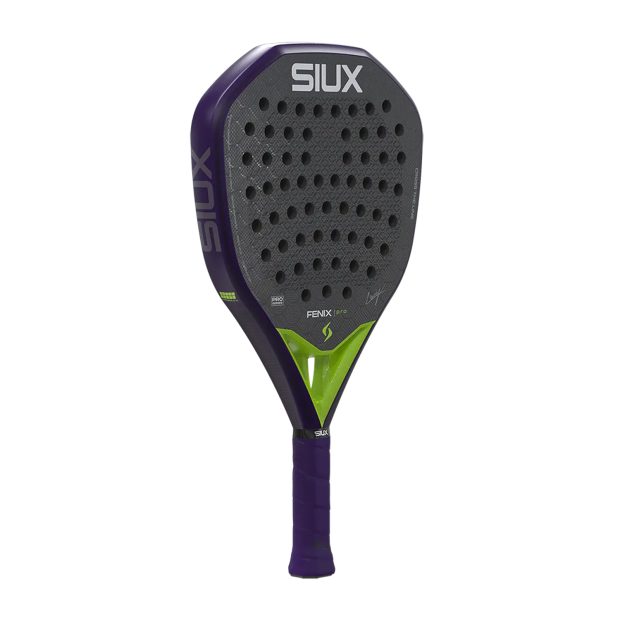
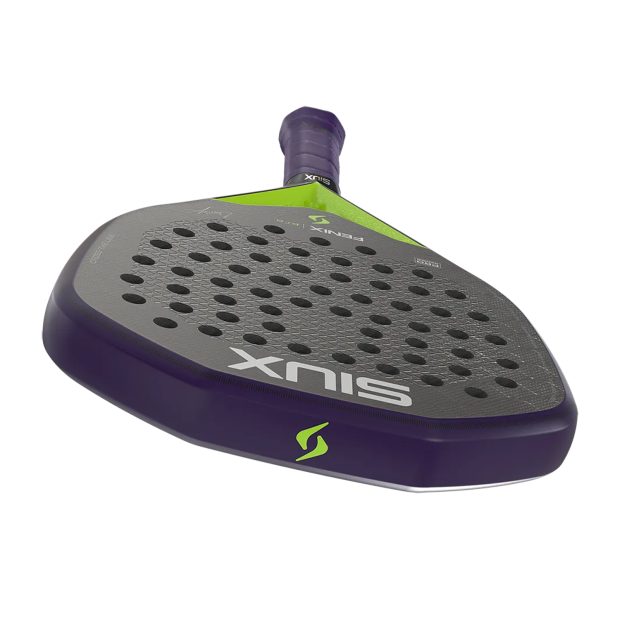
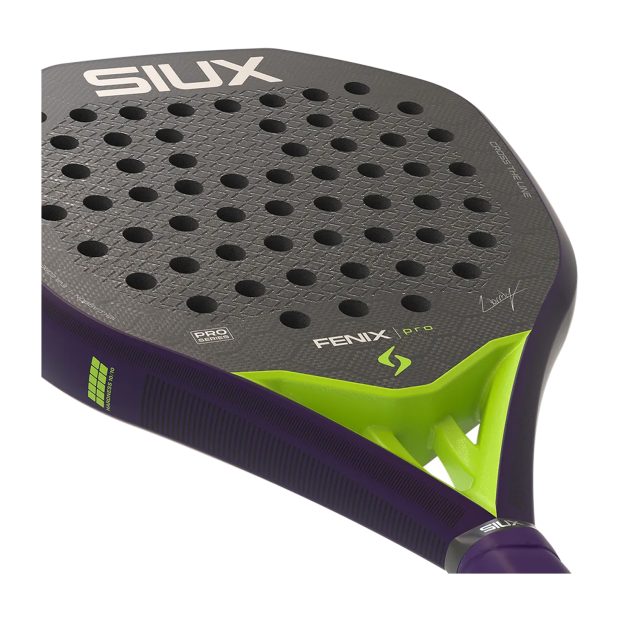
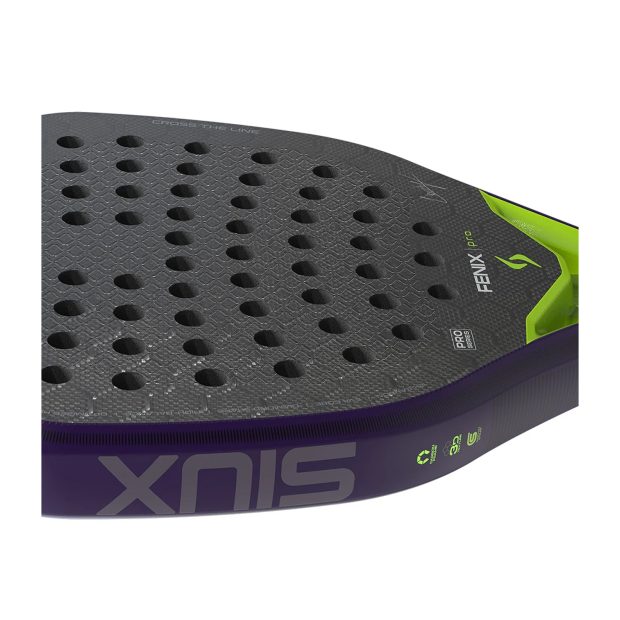
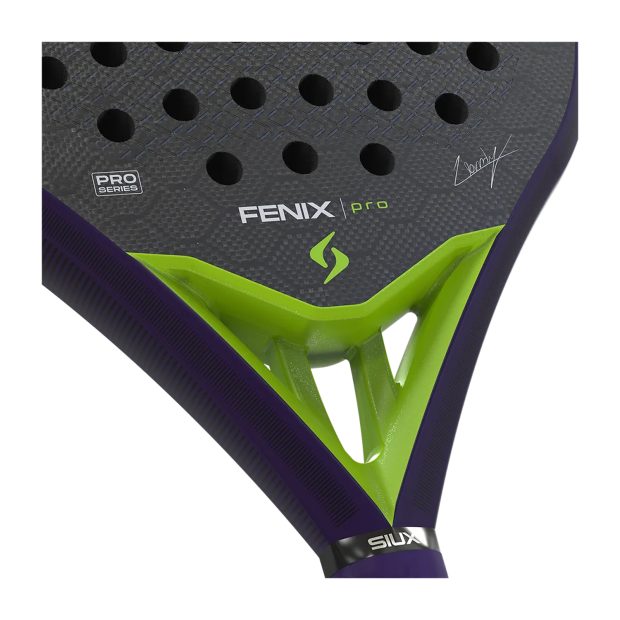
Siux Fenix Pro 6 Padel Racquet 2026 (Glow Purple)
Siux Fenix Pro 6 Padel Racquet is built for advanced and expert left-side attackers who finish points with smashes, viboras, and decisive net play. The Diamond hexagonal shape concentrates maximum mass at the top of the face used by Léo Augsburger’s.
Estimated Delivery Time: 2 - 4 Days (Delivery subject to pincode)
₹57,499.00 Original price was: ₹57,499.00.₹40,222.00Current price is: ₹40,222.00.
Estimated Delivery Time: 2 - 4 Days (Delivery subject to pincode)
Watch this video before Buying
Shop Online
Shop 24/7 with your smartphone
Shipping Worldwide
Free Shipping All Over India
Pay on Delivery
You're in safe hands
Frequently Bought Together
[cuw_fbt]
Product Details
Specification
Description
FAQ's
Specification
| Shape | Diamond — Hexagonal (flat-edged hex-diamond, head-heavy high balance) |
| Face Material | 12K Carbon + 3K Carbon hybrid layup — high rigidity, excellent energy return |
| Surface Texture | 3D Satin Matte Texture — for spin generation and ball traction |
| Core | Hard EVA — high-density, stiff, explosive power feedback (black) |
| Frame | 100% Carbon — Carbon Twin-Tube reinforced structure |
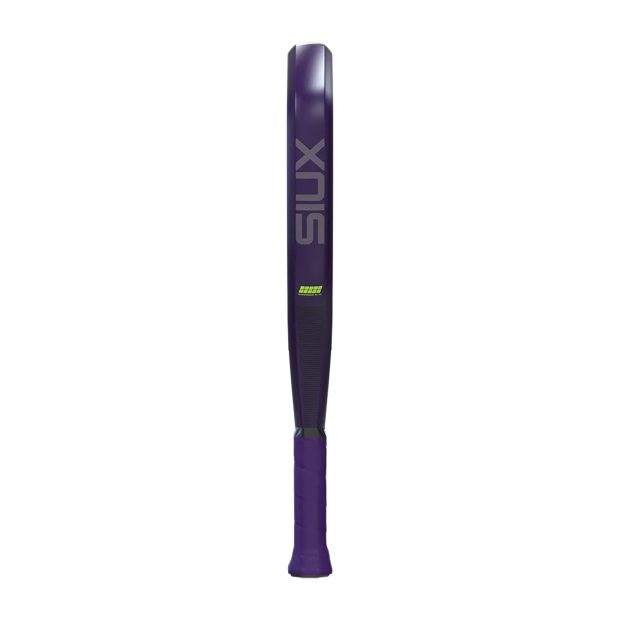
| Frame Profile | 38mm |
| Weight | 355–375g declared |
| Balance | High head-heavy — approximately 274mm balance point |
| Pro Player | Léo Augsburger — WPT / FIP Professional Circuit |
| Edition | 2026 — Fenix Pro VI (6th Generation) |
| Skill Level | Advanced to Expert |
| Playing Style | Maximum Power Offensive |
Description
God of Sports Expert Verdict on the Siux Fenix Pro 6 Padel Racquet:
Siux Fenix Pro 6 Padel Racquet is the 2026 generation of Léo Augsburger’s competition weapon — the sixth iteration of the Fenix Pro line and Siux’s clearest statement of offensive intent. For advanced and expert players who play left side and want a racquet that is uncompromisingly designed to end points, this is where Siux concentrates their highest-performance materials and construction.- Who it is for: Advanced to expert players who play left side, have complete offensive technique — confident smashes, aggressive viboras, authoritative net volleys — and want a racquet that responds to every attacking intent with maximum explosive output. This is Léo Augsburger’s match tool. It reflects his style: decisive, direct, and built to impose.
- What it does best: The diamond hexagonal shape, high head-heavy balance at approximately 274mm, and Hard EVA core combine to produce one of the most explosive smash outputs available in any padel racquet currently sold in India. The 12K + 3K hybrid carbon face is stiff and direct — the ball exits fast, with authority, and with a crisp contact feel that makes attacking intent immediately apparent in the ball’s trajectory.
- The honest caveat: The Fenix Pro 6 is demanding. The Hard EVA core and stiff carbon face punish imprecise contact more sharply than softer alternatives. PadelVerdict’s independent assessment rates Playability at 6.7 and Sweet Spot Size at 7.0 — honest signals that this racquet requires technical consistency, not forgiveness. Players below advanced level, or those with any arm or shoulder sensitivity, should consider the Siux Fenix Lite 4 as a more accessible starting point in the Fenix family.
- GOS verdict: One of the most focused power tools available in India from a Spanish padel brand with deep professional pedigree. If your technique is ready for it, the Fenix Pro 6 delivers the kind of match-winning attacking power that Léo Augsburger has built his professional career on.
Performance Analysis of Siux Fenix Pro 6 Padel Racquet:
- Smashes and Viboras (10/10) : The Fenix Pro 6 excels at this — it is what the entire racquet is designed for. The hexagonal diamond shape and approximately 274mm head-heavy balance create a natural loading position for overheads that generates inertia before the swing has fully accelerated. The Hard EVA core releases that inertia into the ball with an explosive, sharp feel that players consistently describe as immediate and decisive: there is no delay between swing and ball exit, no soft give at contact, just a direct, authoritative transfer of pace. Viboras carry a penetrating, low trajectory quality that the stiff face and high balance promote — the ball does not float or balloon but travels with a taut, flattened arc that makes retrieval genuinely difficult. The 3D satin texture grips naturally at the top of the swing, loading spin without requiring deliberate wrist exaggeration. On Indian artificial grass courts, the Fenix Pro 6’s smash lands heavy and stays low after the bounce — opponents have minimal time and distance to work with on the recovery.
- Bandeja and Lobs (7.5/10) : The Fenix Pro 6 is honest about its limitations here, and so should the buyer be. The Hard EVA core is engineered to amplify pace — which is the opposite of what a well-placed bandeja or a high defensive lob requires. Deceleration through the contact window is harder to control on a stiff core than on a softer one, meaning bandeja placement requires more deliberate technique than on a round or softer-cored racquet. That said, the 3D satin texture and 12K carbon face provide enough ball grip to give experienced players a feel for the shot even at reduced swing speed, and offensive lobs hit at full swing speed — the kind designed to pass opponents at the net — are effective and reliable. The honest picture: the Fenix Pro 6 in the hands of a technically complete advanced player produces functional bandejas. But it is demanding. Players who use the bandeja as their primary point-construction tool from the right side will find the CTRL-style or Fenix Lite profile significantly more natural for that shot.
- Volleys and Blocks (8.5/10) : At the net, the Fenix Pro 6 is effective for players who take the ball early and dictate terms — and genuinely demanding for players whose net game involves reactive scrambling. Punch volleys are authoritative: the Hard EVA core and carbon twin-tube frame inject pace into even compact swings, making first-volley winners accessible from good net position. The Carbon Twin-Tube frame resists twisting on fast incoming volleys, so blocks and reflex volleys from opponents’ counterattacks stay on target without the face rotating. Aggressive approach volleys, X3 finishes, and overhead putaways at the net are all strong. Where the Fenix Pro 6 is less comfortable is on reactive reflex volleys against very fast incoming balls where preparation time is minimal — the Hard EVA core’s firmness makes absorbing pace actively a more deliberate technical task than on a softer model.
- Defense and Wall Play (7/10) : Defense is the Fenix Pro 6’s declared weakness — and PadelVerdict’s independent assessment confirms it with a Defender score 1.23 points below its Attacker score. The Hard EVA core was designed to amplify pace, not absorb it — rushed defensive returns against hard-hit balls come back faster than intended unless you actively dampen the contact with a soft wrist, which is technically demanding under pressure. The head-heavy balance at 274mm slows racquet movement in reactive defensive situations where milliseconds determine whether the ball comes back at all. Wall play from the back glass is competent when you have time to set your feet — the 12K carbon face gives a predictable, consistent response off hard surfaces — but on scrambled glass situations where touch and precise angle reading are everything, the stiff face and hard core work against you. Players who partner the Fenix Pro 6 with strong defensive footwork and a court style that limits exposure to defensive situations — i.e., attacking-minded left-side players who close the net and finish points — find the defense rating adequate. Players who regularly find themselves retreating and defending will find it genuinely difficult. Read our guide on how to use the walls in padel for technique that works with this racquet’s defensive profile.
Technology used in Siux Fenix Pro 6 Padel Racquet:
- 12K + 3K Carbon Hybrid Face — The Fenix Pro 6 uses a dual-layer carbon face construction — an outer 12K carbon weave bonded over a 3K carbon base layer. The 12K layer provides the primary structural rigidity: 12,000 filaments per tow creates a dense, stiff surface that minimises face flex on impact and maximises energy transfer from swing to ball. The 3K layer beneath adds torsional stability — resistance to face twist on off-centre contacts — preventing the power loss and directional inconsistency that occurs when a stiff face deforms laterally under load. The previous Fenix Pro 5 used 24K carbon on the face; the Pro 6’s hybrid 12K + 3K construction is stiffer in torsion while remaining comparably explosive in direct energy transfer. On court: the ball exits fast and with decisive direction. The face does not give feedback that the shot has been mistimed — it gives feedback that the shot has been executed. Crisp, immediate, and unambiguous.
- Hard EVA Core (ULTIMATE TECH Internal Structure) — Hard EVA is the highest-density rubber core compound used across the Siux Fenix family — stiffer and less flexible than standard EVA foams. On impact, Hard EVA resists deformation more than soft alternatives, returning a higher proportion of swing energy into the ball rather than absorbing it within the core. The result is an explosive, direct power output that experienced attacking players describe as sharp and decisive. The ULTIMATE TECH internal structure is a proprietary Siux core architecture that distributes this energy return more evenly across the core face — preventing hot spots where the Hard EVA would otherwise create unpredictably fast exits on certain contact zones while being slower on others. On court: power is consistent across the sweet spot, not just at the dead centre. The core delivers on every hard contact within the hitting zone, not just on perfectly centred ones.
- SHOCKOUT Anti-Vibration System — A damping component integrated into the frame that intercepts and disperses the vibration waves generated on ball impact before they travel fully into the handle and grip. Hard EVA cores inherently produce sharper vibration signatures than soft cores — they return more energy to the ball, but the residual vibration travels into the arm. Without SHOCKOUT, the Fenix Pro 6’s Hard EVA would be significantly more tiring on the arm over an extended session. With it, the sharp vibration edge is reduced to a firm, clear contact feel that experienced players interpret as excellent feedback rather than discomfort. On court: you feel the shot clearly without the stinging aftermath. SHOCKOUT is particularly relevant in Indian conditions where summer heat (30–38°C) causes muscles to fatigue faster and absorb vibration less effectively.
- Diamond Hexagonal Shape — Siux describes the Fenix Pro 6’s head shape as “hexagonal diamond” — a diamond outline with flat-edge geometry around the frame head. This is not a standard round diamond: the flattened edges create a slightly wider hitting zone at the top of the face compared to a pointed-tip diamond, giving the sweet spot more usable area in the high-contact zone where smashes and viboras land. The head-heavy balance — measured at approximately 274mm — positions the centre of mass well above the geometric centre of the racquet, ensuring every overhead swing loads naturally with momentum before the downswing has even started. On court: smash loading is instinctive. The racquet’s weight distribution does the work of positioning; you supply the acceleration.
- 100% Carbon Frame (Carbon Twin-Tube) — The frame is constructed entirely in carbon fibre using a twin-tube profile — two parallel carbon tubes running through the frame that, together, create a stiffer, more rigid structure than a single-tube carbon frame of equivalent weight. The twin-tube geometry resists torsion from all angles simultaneously — crucial for a head-heavy diamond racquet that experiences extreme lateral stress on off-centre smash contacts. On court: the frame does not give on hard contacts. There is no energy lost through frame flex. What you put into the swing comes out in the ball, not in frame deformation.
- 3D Satin Matte Surface Texture — A three-dimensional roughness pattern applied across the entire hitting surface that creates micro-friction between ball and face at contact. The satin matte finish is Siux’s premium surface treatment — a more precisely engineered texture than a simple rough sandpaper finish, producing more consistent spin generation across different contact points on the face. On court: viboras carry reliable rotation without requiring a deliberate extra wrist snap. Bandejas grip the ball naturally through the contact window. Kick smashes angle sharply off Indian artificial grass courts after the bounce. PadelVerdict independently rates Spin at 7.8 on the Fenix Pro 2026 — confirming the texture’s practical effectiveness.
- Spiral Grip — The handle of the Fenix Pro 6 uses a spiral-structured grip layer beneath the factory overgrip — a raised helical pattern that improves tactile purchase on the handle during play. On court: the grip feels more secure in the hand during powerful swings, reducing the micro-slippage that causes off-plane shots on maximum-effort smashes. The spiral structure also promotes natural wrist pronation on overheads — the handle guides the wrist into the correct rotation for a fully committed smash without requiring deliberate technique adjustment. In Indian summer heat, where sweat management is critical, the spiral grip creates air channels that slightly improve breathability under the overgrip, reducing grip saturation during long sessions.
Is Siux Fenix Pro 6 Padel Racquet Right for You?
- Siux Fenix Pro 6 Padel Racquet IS your racquet if you:
- Play advanced to expert level padel, predominantly on the left side
- Have complete offensive technique — consistent smashes, developed viboras, confident aggressive volleys at the net
- Want maximum explosive power output from a Spanish professional-pedigree brand
- Have played the Fenix Pro 5 (2025) and want the refinement of the Pro 6’s 12K hybrid carbon face and improved torsional stability
- Are comfortable with demanding racquets that amplify technique rather than masking it
- Have a well-conditioned arm with no elbow, wrist, or shoulder sensitivity
- Play 3 or more times per week at competitive club or tournament level
- Consider carefully if you:
- Have not played a Hard EVA core racquet before — the contact feel is noticeably firmer and more demanding than soft or medium EVA, and requires an adjustment period
- Play right side more than left — the bandeja and defensive demands of the right side are poorly matched to the Hard EVA core’s character
- Have long sessions (90+ minutes) in Indian summer heat — Hard EVA with head-heavy balance creates meaningful cumulative arm load; SHOCKOUT mitigates but does not eliminate this
- Are upgrading from a fiberglass or soft-carbon model for the first time — the jump to Hard EVA and 12K carbon is significant
Siux Fenix Family — Which Model is Right for Your Level?
| Model | Shape | Face | Core | Power | Control | Best For | Level |
|---|---|---|---|---|---|---|---|
| Fenix Pro 6 (2026) — This racquet | Diamond | 12K + 3K Carbon | Hard EVA | ★★★★★ | ★★★ | Maximum power — left-side offensive finisher | Advanced–Expert |
| Fenix Pro 5 (2025) | Diamond | 24K Carbon | Hard EVA | ★★★★★ | ★★★ | Previous flagship — max power, slightly different carbon feel | Advanced–Expert |
| Fenix Pro 4 (2024) | Diamond | 18K Carbon | Hard EVA | ★★★★ | ★★★ | Offensive diamond — earlier generation Pro | Advanced–Expert |
| Fenix Lite 4 (2024) | Diamond | 3K Carbon | Hard EVA | ★★★★ | ★★★★ | More accessible diamond — wider sweet spot | Intermediate–Advanced |
Cross-Brand Comparison — Siux Fenix Pro 6 vs the Best Power Racquets in the Market
| Racquet | Brand | Shape | Face | Core | Touch | Pro Player |
|---|---|---|---|---|---|---|
| Siux Fenix Pro 6 — This racquet | Siux | Diamond | 12K + 3K Carbon | Hard EVA | Sharp, direct, explosive | Léo Augsburger |
| Adidas Metalbone 3.5 | Adidas | Diamond | 16K Aluminized Carbon | Soft EVA | Dry, fast, direct | Ale Galán |
| HEAD Coello Pro 2026 | HEAD | Diamond | Carbon Hybrid HS | Power Foam | Explosive, connected | Arturo Coello |
| Babolat Technical Viper | Babolat | Diamond | Carbon Flex (12K + Fiberglass) | EVA Soft | Stiff, dry, demanding | Juan Lebrón |
| NOX AT10 Attack 18K Alum | NOX | Hybrid / Teardrop | 18K Aluminized | EVA | Medium-firm, versatile | Agustín Tapia |
- Siux Fenix Pro 6 vs Adidas Metalbone 3.5 : Both are elite-level left-side diamond weapons, but their core philosophy differs fundamentally. The Metalbone 3.5 uses Soft EVA with a 16K Aluminized Carbon face — explosive pace comes from the stiff face and head-heavy balance, but the Soft EVA core cushions the impact and makes the racquet more manageable over long sessions. The Fenix Pro 6 uses Hard EVA — amplifying impact energy even further, producing a sharper, more decisive contact feel. The Fenix Pro 6 hits harder and more explosively; the Metalbone 3.5 is more arm-friendly and more consistent over a long match in heat. Both have approximately 274mm head-heavy balance. Choose the Fenix Pro 6 for the most explosive, sharpest-feeling power output available. Choose the Metalbone 3.5 for elite-level power with better arm comfort and a more established ecosystem in the Indian market.
- Siux Fenix Pro 6 vs HEAD Coello Pro 2026 : The HEAD Coello Pro 2026 is Arturo Coello’s match weapon — approximately 370g with a 272mm high balance, Carbon Hybrid HS face, and Power Foam core. The Power Foam is designed to amplify energy return on fast contacts, but it does so with more connection and tactile feel than Hard EVA — the Coello Pro is explosive and connected; the Fenix Pro 6 is explosive and sharp. The Coello Pro is 10–15g heavier and slightly more head-heavy than most Fenix Pro 6 units; the Fenix Pro 6 is faster to swing. Choose the Fenix Pro 6 for a lighter, faster-swinging explosive diamond with a sharper Hard EVA feel. Choose the Coello Pro for heavier swing weight, a more connected face sensation, and the HEAD build quality Indian players are already familiar with.
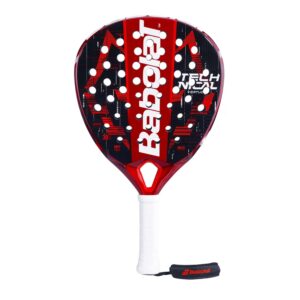
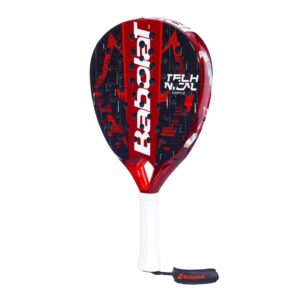
- Siux Fenix Pro 6 vs Babolat Technical Viper : The Babolat Technical Viper is Juan Lebrón’s racquet — a demanding diamond for pro-level play, with a Carbon Flex face (12K carbon + fiberglass hybrid) and Soft EVA core. The Viper’s face is drier and more direct than many diamonds but remains warmer than the Fenix Pro 6’s Hard EVA. The Fenix Pro 6’s hard core makes its power output even more uncompromising than the Viper’s. The Viper is associated with Lebrón’s technical right-side precision; the Fenix Pro 6 with Augsburger’s explosive left-side power. Your court position and attack style determine the choice. Both are built for pro-level play — the Fenix Pro 6 is the harder, more explosive option; the Viper adds slightly more touch through its hybrid face.
- All Siux Padel Racquets at God of Sports
- Adidas Padel Racquets
- HEAD Padel Racquets
- NOX Padel Racquets
- Babolat Padel Racquets
- Padel Accessories : Overgrips, Protector Tape, Wrist Straps and More
- Padel Racquets in India
- Shop the Full Padel Collection at God of Sports
FAQ's
Yes, for the right player profile — and no, for everyone else. The Fenix Pro 6 suits advanced Indian club players who play 3 or more times per week, predominantly on the left side, with a consistently aggressive attacking game. The Hard EVA core’s explosive feel is genuine and rewards clean, committed technique. However, Indian summer conditions (30–38°C, March–June) amplify the arm load from Hard EVA racquets — SHOCKOUT mitigates this, but players with long sessions or multiple matches per day should monitor arm fatigue carefully. If you are at advanced club level but play longer, more defensive sessions or play right side regularly, the Adidas Metalbone 3.5 or HEAD Coello Pro 2026 may offer a more sustainable power-to-comfort balance for Indian conditions.
This is one of the most important questions for Indian players considering the Fenix Pro 6. Hard EVA transmits more vibration to the arm than soft EVA — it returns more energy to the ball, but the residual vibration signature is sharper. In Indian summer heat (30–38°C in Mumbai, Delhi, Pune from March to June), arm muscles fatigue faster and absorb vibration less effectively. For players with strong, conditioned arms who play consistently, the SHOCKOUT system provides meaningful protection. For players with occasional arm soreness, sensitivity, or irregular training schedules, the Fenix Pro 6’s Hard EVA is a genuine risk. Practical advice: always warm up thoroughly before using a Hard EVA racquet, keep session length to 75 minutes maximum in heat above 33°C, replace overgrip before every session to maintain grip pressure control, and monitor for elbow or forearm soreness after first use. All overgrips and padel accessories available at GOS.
| Shape | Diamond — Hexagonal (flat-edged hex-diamond, head-heavy high balance) |
| Face Material | 12K Carbon + 3K Carbon hybrid layup — high rigidity, excellent energy return |
| Surface Texture | 3D Satin Matte Texture — for spin generation and ball traction |
| Core | Hard EVA — high-density, stiff, explosive power feedback (black) |
| Frame | 100% Carbon — Carbon Twin-Tube reinforced structure |
| Frame Profile | 38mm |
| Weight | 355–375g declared |
| Balance | High head-heavy — approximately 274mm balance point |
| Pro Player | Léo Augsburger — WPT / FIP Professional Circuit |
| Edition | 2026 — Fenix Pro VI (6th Generation) |
| Skill Level | Advanced to Expert |
| Playing Style | Maximum Power Offensive |
God of Sports Expert Verdict on the Siux Fenix Pro 6 Padel Racquet:
Siux Fenix Pro 6 Padel Racquet is the 2026 generation of Léo Augsburger’s competition weapon — the sixth iteration of the Fenix Pro line and Siux’s clearest statement of offensive intent. For advanced and expert players who play left side and want a racquet that is uncompromisingly designed to end points, this is where Siux concentrates their highest-performance materials and construction.- Who it is for: Advanced to expert players who play left side, have complete offensive technique — confident smashes, aggressive viboras, authoritative net volleys — and want a racquet that responds to every attacking intent with maximum explosive output. This is Léo Augsburger’s match tool. It reflects his style: decisive, direct, and built to impose.
- What it does best: The diamond hexagonal shape, high head-heavy balance at approximately 274mm, and Hard EVA core combine to produce one of the most explosive smash outputs available in any padel racquet currently sold in India. The 12K + 3K hybrid carbon face is stiff and direct — the ball exits fast, with authority, and with a crisp contact feel that makes attacking intent immediately apparent in the ball’s trajectory.
- The honest caveat: The Fenix Pro 6 is demanding. The Hard EVA core and stiff carbon face punish imprecise contact more sharply than softer alternatives. PadelVerdict’s independent assessment rates Playability at 6.7 and Sweet Spot Size at 7.0 — honest signals that this racquet requires technical consistency, not forgiveness. Players below advanced level, or those with any arm or shoulder sensitivity, should consider the Siux Fenix Lite 4 as a more accessible starting point in the Fenix family.
- GOS verdict: One of the most focused power tools available in India from a Spanish padel brand with deep professional pedigree. If your technique is ready for it, the Fenix Pro 6 delivers the kind of match-winning attacking power that Léo Augsburger has built his professional career on.
Performance Analysis of Siux Fenix Pro 6 Padel Racquet:
- Smashes and Viboras (10/10) : The Fenix Pro 6 excels at this — it is what the entire racquet is designed for. The hexagonal diamond shape and approximately 274mm head-heavy balance create a natural loading position for overheads that generates inertia before the swing has fully accelerated. The Hard EVA core releases that inertia into the ball with an explosive, sharp feel that players consistently describe as immediate and decisive: there is no delay between swing and ball exit, no soft give at contact, just a direct, authoritative transfer of pace. Viboras carry a penetrating, low trajectory quality that the stiff face and high balance promote — the ball does not float or balloon but travels with a taut, flattened arc that makes retrieval genuinely difficult. The 3D satin texture grips naturally at the top of the swing, loading spin without requiring deliberate wrist exaggeration. On Indian artificial grass courts, the Fenix Pro 6’s smash lands heavy and stays low after the bounce — opponents have minimal time and distance to work with on the recovery.
- Bandeja and Lobs (7.5/10) : The Fenix Pro 6 is honest about its limitations here, and so should the buyer be. The Hard EVA core is engineered to amplify pace — which is the opposite of what a well-placed bandeja or a high defensive lob requires. Deceleration through the contact window is harder to control on a stiff core than on a softer one, meaning bandeja placement requires more deliberate technique than on a round or softer-cored racquet. That said, the 3D satin texture and 12K carbon face provide enough ball grip to give experienced players a feel for the shot even at reduced swing speed, and offensive lobs hit at full swing speed — the kind designed to pass opponents at the net — are effective and reliable. The honest picture: the Fenix Pro 6 in the hands of a technically complete advanced player produces functional bandejas. But it is demanding. Players who use the bandeja as their primary point-construction tool from the right side will find the CTRL-style or Fenix Lite profile significantly more natural for that shot.
- Volleys and Blocks (8.5/10) : At the net, the Fenix Pro 6 is effective for players who take the ball early and dictate terms — and genuinely demanding for players whose net game involves reactive scrambling. Punch volleys are authoritative: the Hard EVA core and carbon twin-tube frame inject pace into even compact swings, making first-volley winners accessible from good net position. The Carbon Twin-Tube frame resists twisting on fast incoming volleys, so blocks and reflex volleys from opponents’ counterattacks stay on target without the face rotating. Aggressive approach volleys, X3 finishes, and overhead putaways at the net are all strong. Where the Fenix Pro 6 is less comfortable is on reactive reflex volleys against very fast incoming balls where preparation time is minimal — the Hard EVA core’s firmness makes absorbing pace actively a more deliberate technical task than on a softer model.
- Defense and Wall Play (7/10) : Defense is the Fenix Pro 6’s declared weakness — and PadelVerdict’s independent assessment confirms it with a Defender score 1.23 points below its Attacker score. The Hard EVA core was designed to amplify pace, not absorb it — rushed defensive returns against hard-hit balls come back faster than intended unless you actively dampen the contact with a soft wrist, which is technically demanding under pressure. The head-heavy balance at 274mm slows racquet movement in reactive defensive situations where milliseconds determine whether the ball comes back at all. Wall play from the back glass is competent when you have time to set your feet — the 12K carbon face gives a predictable, consistent response off hard surfaces — but on scrambled glass situations where touch and precise angle reading are everything, the stiff face and hard core work against you. Players who partner the Fenix Pro 6 with strong defensive footwork and a court style that limits exposure to defensive situations — i.e., attacking-minded left-side players who close the net and finish points — find the defense rating adequate. Players who regularly find themselves retreating and defending will find it genuinely difficult. Read our guide on how to use the walls in padel for technique that works with this racquet’s defensive profile.
Technology used in Siux Fenix Pro 6 Padel Racquet:
- 12K + 3K Carbon Hybrid Face — The Fenix Pro 6 uses a dual-layer carbon face construction — an outer 12K carbon weave bonded over a 3K carbon base layer. The 12K layer provides the primary structural rigidity: 12,000 filaments per tow creates a dense, stiff surface that minimises face flex on impact and maximises energy transfer from swing to ball. The 3K layer beneath adds torsional stability — resistance to face twist on off-centre contacts — preventing the power loss and directional inconsistency that occurs when a stiff face deforms laterally under load. The previous Fenix Pro 5 used 24K carbon on the face; the Pro 6’s hybrid 12K + 3K construction is stiffer in torsion while remaining comparably explosive in direct energy transfer. On court: the ball exits fast and with decisive direction. The face does not give feedback that the shot has been mistimed — it gives feedback that the shot has been executed. Crisp, immediate, and unambiguous.
- Hard EVA Core (ULTIMATE TECH Internal Structure) — Hard EVA is the highest-density rubber core compound used across the Siux Fenix family — stiffer and less flexible than standard EVA foams. On impact, Hard EVA resists deformation more than soft alternatives, returning a higher proportion of swing energy into the ball rather than absorbing it within the core. The result is an explosive, direct power output that experienced attacking players describe as sharp and decisive. The ULTIMATE TECH internal structure is a proprietary Siux core architecture that distributes this energy return more evenly across the core face — preventing hot spots where the Hard EVA would otherwise create unpredictably fast exits on certain contact zones while being slower on others. On court: power is consistent across the sweet spot, not just at the dead centre. The core delivers on every hard contact within the hitting zone, not just on perfectly centred ones.
- SHOCKOUT Anti-Vibration System — A damping component integrated into the frame that intercepts and disperses the vibration waves generated on ball impact before they travel fully into the handle and grip. Hard EVA cores inherently produce sharper vibration signatures than soft cores — they return more energy to the ball, but the residual vibration travels into the arm. Without SHOCKOUT, the Fenix Pro 6’s Hard EVA would be significantly more tiring on the arm over an extended session. With it, the sharp vibration edge is reduced to a firm, clear contact feel that experienced players interpret as excellent feedback rather than discomfort. On court: you feel the shot clearly without the stinging aftermath. SHOCKOUT is particularly relevant in Indian conditions where summer heat (30–38°C) causes muscles to fatigue faster and absorb vibration less effectively.
- Diamond Hexagonal Shape — Siux describes the Fenix Pro 6’s head shape as “hexagonal diamond” — a diamond outline with flat-edge geometry around the frame head. This is not a standard round diamond: the flattened edges create a slightly wider hitting zone at the top of the face compared to a pointed-tip diamond, giving the sweet spot more usable area in the high-contact zone where smashes and viboras land. The head-heavy balance — measured at approximately 274mm — positions the centre of mass well above the geometric centre of the racquet, ensuring every overhead swing loads naturally with momentum before the downswing has even started. On court: smash loading is instinctive. The racquet’s weight distribution does the work of positioning; you supply the acceleration.
- 100% Carbon Frame (Carbon Twin-Tube) — The frame is constructed entirely in carbon fibre using a twin-tube profile — two parallel carbon tubes running through the frame that, together, create a stiffer, more rigid structure than a single-tube carbon frame of equivalent weight. The twin-tube geometry resists torsion from all angles simultaneously — crucial for a head-heavy diamond racquet that experiences extreme lateral stress on off-centre smash contacts. On court: the frame does not give on hard contacts. There is no energy lost through frame flex. What you put into the swing comes out in the ball, not in frame deformation.
- 3D Satin Matte Surface Texture — A three-dimensional roughness pattern applied across the entire hitting surface that creates micro-friction between ball and face at contact. The satin matte finish is Siux’s premium surface treatment — a more precisely engineered texture than a simple rough sandpaper finish, producing more consistent spin generation across different contact points on the face. On court: viboras carry reliable rotation without requiring a deliberate extra wrist snap. Bandejas grip the ball naturally through the contact window. Kick smashes angle sharply off Indian artificial grass courts after the bounce. PadelVerdict independently rates Spin at 7.8 on the Fenix Pro 2026 — confirming the texture’s practical effectiveness.
- Spiral Grip — The handle of the Fenix Pro 6 uses a spiral-structured grip layer beneath the factory overgrip — a raised helical pattern that improves tactile purchase on the handle during play. On court: the grip feels more secure in the hand during powerful swings, reducing the micro-slippage that causes off-plane shots on maximum-effort smashes. The spiral structure also promotes natural wrist pronation on overheads — the handle guides the wrist into the correct rotation for a fully committed smash without requiring deliberate technique adjustment. In Indian summer heat, where sweat management is critical, the spiral grip creates air channels that slightly improve breathability under the overgrip, reducing grip saturation during long sessions.
Is Siux Fenix Pro 6 Padel Racquet Right for You?
- Siux Fenix Pro 6 Padel Racquet IS your racquet if you:
- Play advanced to expert level padel, predominantly on the left side
- Have complete offensive technique — consistent smashes, developed viboras, confident aggressive volleys at the net
- Want maximum explosive power output from a Spanish professional-pedigree brand
- Have played the Fenix Pro 5 (2025) and want the refinement of the Pro 6’s 12K hybrid carbon face and improved torsional stability
- Are comfortable with demanding racquets that amplify technique rather than masking it
- Have a well-conditioned arm with no elbow, wrist, or shoulder sensitivity
- Play 3 or more times per week at competitive club or tournament level
- Consider carefully if you:
- Have not played a Hard EVA core racquet before — the contact feel is noticeably firmer and more demanding than soft or medium EVA, and requires an adjustment period
- Play right side more than left — the bandeja and defensive demands of the right side are poorly matched to the Hard EVA core’s character
- Have long sessions (90+ minutes) in Indian summer heat — Hard EVA with head-heavy balance creates meaningful cumulative arm load; SHOCKOUT mitigates but does not eliminate this
- Are upgrading from a fiberglass or soft-carbon model for the first time — the jump to Hard EVA and 12K carbon is significant
Siux Fenix Family — Which Model is Right for Your Level?
| Model | Shape | Face | Core | Power | Control | Best For | Level |
|---|---|---|---|---|---|---|---|
| Fenix Pro 6 (2026) — This racquet | Diamond | 12K + 3K Carbon | Hard EVA | ★★★★★ | ★★★ | Maximum power — left-side offensive finisher | Advanced–Expert |
| Fenix Pro 5 (2025) | Diamond | 24K Carbon | Hard EVA | ★★★★★ | ★★★ | Previous flagship — max power, slightly different carbon feel | Advanced–Expert |
| Fenix Pro 4 (2024) | Diamond | 18K Carbon | Hard EVA | ★★★★ | ★★★ | Offensive diamond — earlier generation Pro | Advanced–Expert |
| Fenix Lite 4 (2024) | Diamond | 3K Carbon | Hard EVA | ★★★★ | ★★★★ | More accessible diamond — wider sweet spot | Intermediate–Advanced |
Cross-Brand Comparison — Siux Fenix Pro 6 vs the Best Power Racquets in the Market
| Racquet | Brand | Shape | Face | Core | Touch | Pro Player |
|---|---|---|---|---|---|---|
| Siux Fenix Pro 6 — This racquet | Siux | Diamond | 12K + 3K Carbon | Hard EVA | Sharp, direct, explosive | Léo Augsburger |
| Adidas Metalbone 3.5 | Adidas | Diamond | 16K Aluminized Carbon | Soft EVA | Dry, fast, direct | Ale Galán |
| HEAD Coello Pro 2026 | HEAD | Diamond | Carbon Hybrid HS | Power Foam | Explosive, connected | Arturo Coello |
| Babolat Technical Viper | Babolat | Diamond | Carbon Flex (12K + Fiberglass) | EVA Soft | Stiff, dry, demanding | Juan Lebrón |
| NOX AT10 Attack 18K Alum | NOX | Hybrid / Teardrop | 18K Aluminized | EVA | Medium-firm, versatile | Agustín Tapia |
- Siux Fenix Pro 6 vs Adidas Metalbone 3.5 : Both are elite-level left-side diamond weapons, but their core philosophy differs fundamentally. The Metalbone 3.5 uses Soft EVA with a 16K Aluminized Carbon face — explosive pace comes from the stiff face and head-heavy balance, but the Soft EVA core cushions the impact and makes the racquet more manageable over long sessions. The Fenix Pro 6 uses Hard EVA — amplifying impact energy even further, producing a sharper, more decisive contact feel. The Fenix Pro 6 hits harder and more explosively; the Metalbone 3.5 is more arm-friendly and more consistent over a long match in heat. Both have approximately 274mm head-heavy balance. Choose the Fenix Pro 6 for the most explosive, sharpest-feeling power output available. Choose the Metalbone 3.5 for elite-level power with better arm comfort and a more established ecosystem in the Indian market.
- Siux Fenix Pro 6 vs HEAD Coello Pro 2026 : The HEAD Coello Pro 2026 is Arturo Coello’s match weapon — approximately 370g with a 272mm high balance, Carbon Hybrid HS face, and Power Foam core. The Power Foam is designed to amplify energy return on fast contacts, but it does so with more connection and tactile feel than Hard EVA — the Coello Pro is explosive and connected; the Fenix Pro 6 is explosive and sharp. The Coello Pro is 10–15g heavier and slightly more head-heavy than most Fenix Pro 6 units; the Fenix Pro 6 is faster to swing. Choose the Fenix Pro 6 for a lighter, faster-swinging explosive diamond with a sharper Hard EVA feel. Choose the Coello Pro for heavier swing weight, a more connected face sensation, and the HEAD build quality Indian players are already familiar with.
- Siux Fenix Pro 6 vs Babolat Technical Viper : The Babolat Technical Viper is Juan Lebrón’s racquet — a demanding diamond for pro-level play, with a Carbon Flex face (12K carbon + fiberglass hybrid) and Soft EVA core. The Viper’s face is drier and more direct than many diamonds but remains warmer than the Fenix Pro 6’s Hard EVA. The Fenix Pro 6’s hard core makes its power output even more uncompromising than the Viper’s. The Viper is associated with Lebrón’s technical right-side precision; the Fenix Pro 6 with Augsburger’s explosive left-side power. Your court position and attack style determine the choice. Both are built for pro-level play — the Fenix Pro 6 is the harder, more explosive option; the Viper adds slightly more touch through its hybrid face.
- All Siux Padel Racquets at God of Sports
- Adidas Padel Racquets
- HEAD Padel Racquets
- NOX Padel Racquets
- Babolat Padel Racquets
- Padel Accessories : Overgrips, Protector Tape, Wrist Straps and More
- Padel Racquets in India
- Shop the Full Padel Collection at God of Sports
Yes, for the right player profile — and no, for everyone else. The Fenix Pro 6 suits advanced Indian club players who play 3 or more times per week, predominantly on the left side, with a consistently aggressive attacking game. The Hard EVA core’s explosive feel is genuine and rewards clean, committed technique. However, Indian summer conditions (30–38°C, March–June) amplify the arm load from Hard EVA racquets — SHOCKOUT mitigates this, but players with long sessions or multiple matches per day should monitor arm fatigue carefully. If you are at advanced club level but play longer, more defensive sessions or play right side regularly, the Adidas Metalbone 3.5 or HEAD Coello Pro 2026 may offer a more sustainable power-to-comfort balance for Indian conditions.
This is one of the most important questions for Indian players considering the Fenix Pro 6. Hard EVA transmits more vibration to the arm than soft EVA — it returns more energy to the ball, but the residual vibration signature is sharper. In Indian summer heat (30–38°C in Mumbai, Delhi, Pune from March to June), arm muscles fatigue faster and absorb vibration less effectively. For players with strong, conditioned arms who play consistently, the SHOCKOUT system provides meaningful protection. For players with occasional arm soreness, sensitivity, or irregular training schedules, the Fenix Pro 6’s Hard EVA is a genuine risk. Practical advice: always warm up thoroughly before using a Hard EVA racquet, keep session length to 75 minutes maximum in heat above 33°C, replace overgrip before every session to maintain grip pressure control, and monitor for elbow or forearm soreness after first use. All overgrips and padel accessories available at GOS.
Customer Reviews
Products from same brand
Joola Perseus Heat Vision Pickleball Paddle (Blaze Red)
Joola Agassi Edge Heat Vision Pickleball Paddle (Blaze Red)
JOOLA Primo Pickleballs (Pack of 100)
Similar Products
FirstEdge Dynamex 12K Carbon Padel Racquet
HEAD Antishock Padel Racquet Protector Tape
HEAD Radical Elite 2024 Padel Racquet
HEAD Gravity Team 2024 Padel Racquet
Recently Viewed
God's Advice

Best Padel Racquet in India 2026
By
Sports Analyst
March 24, 2026
Best Badminton Racquet for Beginners in India 2026
By
Sports Analyst
March 24, 2026
Best Pickleball Balls in India 2026
By
Sports Analyst
February 27, 2026