


Maxbolt Blade Badminton Racket
Maxbolt Blade is a 4U, even-balance, medium-flex racket for intermediate players, built for reliable, versatile everyday play without specialising in one style.


Estimated Delivery Time: 3 - 6 Days (Delivery subject to pincode)
GOS's Opinion
Know MoreHow you'd like your racquet:

GOS's Opinion
A balanced, no-fuss intermediate frame that gives you a bit of everything, reliable for club players who want a versatile everyday racket without overthinking it.

Product Details
| Brand | Maxbolt |
| Model | Blade |
| Series | Blade |
| Weight / Grip | 4U (Avg. 83g) / G5 |
| Balance | Even |
| Flex | Medium |
| Frame Material | High Modulus Graphite |
| Shaft Material | Carbon Fibre Composite |
| Max Tension | Up to 35 lbs |
| Player Level | Intermediate |
| MRP | Rs. 4,990 (inclusive of all taxes) |
God of Sports Expert Verdict on Maxbolt Blade Badminton Racket:
- The Blade is a straightforward, even-balance racket built to give a bit of everything without specialising in attack, defence, or speed.
- A medium flex keeps the frame easy to use across a full session, without the technique demands of a stiffer shaft.
- This is a genuinely no-fuss racket - the appeal is reliability and versatility rather than a standout feature.
- This is the racket for a club player who wants one dependable everyday frame and doesn't want to overthink the choice.
Technology Breakdown:
- Even Balance — no specialisation, no weaknesses: Weight distributed evenly along the frame keeps handling consistent whether you're attacking, defending, or playing at the net.
- Medium Flex — easy to use across a full session: Doesn't demand advanced technique to generate usable pace, while still offering reasonable control.
- Carbon Fibre Composite Shaft — dependable, straightforward construction: A simple, no-frills build aimed at reliability rather than chasing a specific performance edge.
Performance Ratings:
| Category | Score (/10) | Notes |
| Attack | 7 | Competent rather than specialised - this racket covers attack without being built purely around it. |
| Defence | 7 | An even or lighter balance helps recovery and defensive resets. |
| Net Area | 7 | Fast handling helps keep net exchanges controlled. |
| Control | 7 | A medium shaft rewards clean technique with precise placement. |
On Court Performance Analysis:
-
Tosses & Clears
- Clears are workable but not a standout - the even-to-light balance keeps things controllable without offering much free assistance on length.
-
Smashes
- Smashing is solid and dependable rather than explosive - enough pace to finish a rally against club-level opposition, without the outright weight of a dedicated attacking frame.
-
Flat Exchanges
- Flat exchanges are competent and controllable, without being the racket's standout strength.
-
Defence
- Defence is dependable and controlled, without being the single biggest strength on this frame.
-
Net Dribbles
- Net dribbles are solid and controllable, with reasonable feel for tight exchanges close to the tape.
-
Handling Speed
- Handling speed is balanced and predictable - quick enough for club-level exchanges without being a dedicated speed frame.
Racket Finder — Is This Right for You?
- Club players who want one versatile everyday racket: the even balance and medium flex cover attack, defence and net play competently without specialising.
- Players who don't want to overthink their racket choice: a genuinely no-fuss, dependable frame built around reliability.
- Not for you if you want a specialised attacking or speed racket: a head-heavy frame like the Thunderbolt or a lighter speed frame like the Superstar Nova would suit a more specific priority better.
Playing Style Guide:
-
Rearcourt / Attacking Player
- Usable but not specialised - an even balance means you won't get the extra smash weight a head-heavy frame provides.
-
Frontcourt / Net Player
- Comfortable and dependable at the net thanks to the even balance.
-
All-Round / Singles Player
- This is where the Blade is built to perform - a genuinely versatile frame for a singles player who needs to cover the whole court.
-
Doubles Player
- Workable for doubles, with the even balance helping with both attacking and defensive exchanges within a rally.
Same-Brand Comparison — Other Maxbolt Rackets:
| Model | Weight | Balance | Flex | Max Tension | Best For |
| Woven Tech 90 (LE) | 4U | Slight Head Heavy | Medium | 35 lbs | Consistent, reliable all-round placement |
| Woven Gold | 4U | Head Heavy | Flexible | 35 lbs | A genuine do-everything frame with no weakness |
| Black Woven LE | 4U | Head Heavy | Medium | 35 lbs | Fast handling with a solid, consistent feel |
Cross-Brand Comparison:
| Model | Brand | Weight | Balance | Flex | Best For |
| Yonex Arcsaber 11 Play | Yonex | 4U | Even | Medium | A control-first alternative for net play and defence over raw smash power |
| Li-Ning Tectonic 1 | Li-Ning | 4U | Even | Flexible | A forgiving, flexible all-round frame for easy rallies |
Other Maxbolt Rackets also at God of Sports:
Is the Maxbolt Blade a good everyday club racket?
Yes - it's built specifically for that. The even balance and medium flex cover attack, defence and net play competently without specialising in one, which suits a club player who wants a dependable racket without overthinking the choice.
What makes the Blade different from Maxbolt's other all-round rackets?
The Blade is a simpler, more straightforward build than the Woven-family rackets, without the woven carbon construction or a standout feature to point to. Its appeal is reliability and versatility at an accessible price, not a specific performance edge.
What string tension does the Blade take?
It's rated up to 35 lbs, a reasonable range for an all-round racket - most club players won't need to string near the top of that ceiling.
Who should buy the Maxbolt Blade?
A club player who wants one dependable, versatile everyday racket without a specialised attacking or speed focus. If you want a racket built around a specific style - power, speed, or precision control - a more specialised Maxbolt racket would suit that better.
Is the Blade head-heavy or even-balanced?
Even-balanced, which is why it handles attack, defence and net play all reasonably well without excelling at any one - a deliberate trade-off for a genuinely versatile frame.
Can a beginner use the Blade?
It's positioned for intermediate players, though its even balance and medium flex are forgiving enough that an improving beginner could reasonably use it too, especially compared with a stiffer, more specialised attacking frame.
Does the Blade suit singles or doubles better?
It works well in both, since its strength is covering every part of the game rather than specialising. In singles it suits a player who wants a versatile all-round game; in doubles its even handling helps with both attacking and defensive exchanges.
Similar Products




Recently Viewed
God's Advice
 Maxbolt Predator Badminton Racket Review — Your First Proper Attacking Racket
By GOS TeamOctober 22, 2026
 Maxbolt Thunderbolt Badminton Racket Review — Smash-First Badminton at an Entry Price
By GOS TeamOctober 22, 2026
 Maxbolt Superstar 10 Badminton Racket Review — The 3U Superstar for Precise Power
By GOS TeamOctober 22, 2026
 Maxbolt Silver Badminton Racket Review — Ultra-Light Speed for Long Doubles Sessions
By GOS TeamOctober 21, 2026
 Maxbolt Gallant Force Badminton Racket Review — Gallant Power in a More Forgiving Frame
By GOS TeamOctober 21, 2026
 Maxbolt Gallant Sakiko Badminton Racket Review — The Accessible Way Into Gallant Attack
By GOS TeamOctober 21, 2026
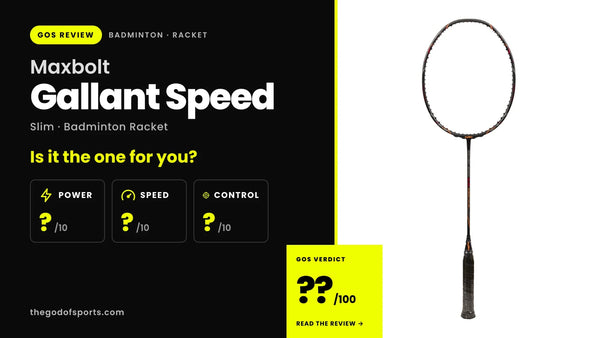 Maxbolt Gallant Speed Slim Badminton Racket Review — The Speed Racket of the Gallant Family
By GOS TeamOctober 21, 2026
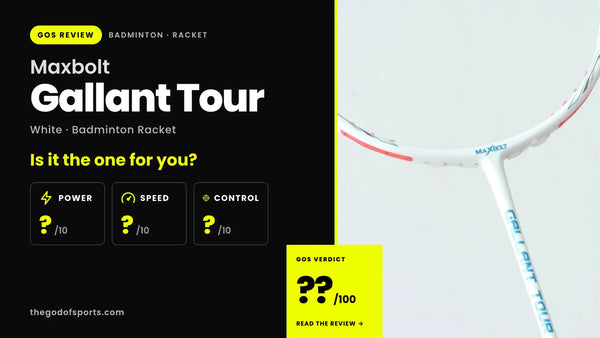 Maxbolt Gallant Tour Badminton Racket Review — Maxbolt's All-Out Attacking Flagship
By GOS TeamOctober 21, 2026
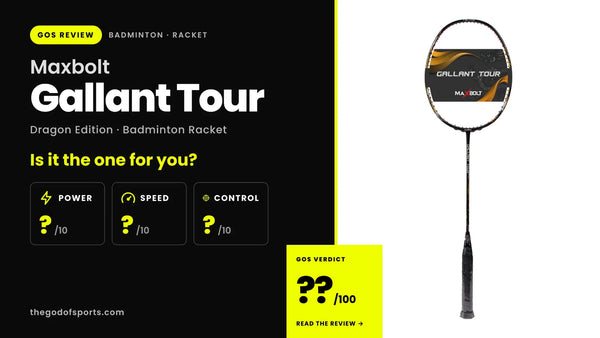 Maxbolt Gallant Tour Dragon Edition Badminton Racket Review — The Lighter 4U Gallant Tour
By GOS TeamOctober 21, 2026
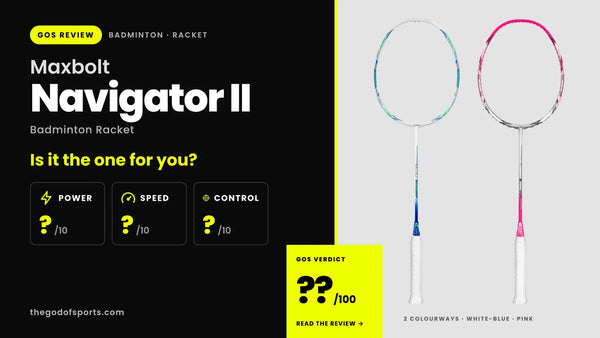 Maxbolt Navigator II Badminton Racket Review — Controlled Power for Improving Players
By GOS TeamOctober 21, 2026
 Maxbolt Woven Gold Badminton Racket Review — The Forgiving All-Rounder With No Weak Zone
By GOS TeamOctober 20, 2026
 Maxbolt Superstar 11 Badminton Racket Review — One Racket for Every Part of the Rally
By GOS TeamOctober 20, 2026
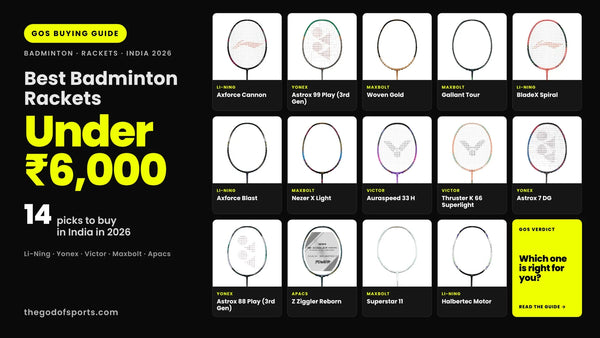 Best Badminton Rackets Under ₹6,000 in India 2026 - by God of Sports
By GOS TeamOctober 18, 2026
 Li-Ning Axforce Cannon Review — 4U vs 5U vs 6U, Which Weight Is Right for You?
By GOS TeamOctober 18, 2026
 Hundred Z Tronic 100 Badminton Racket Review — A Slim, Stiff, Head-Heavy Smasher
By GOS TeamOctober 18, 2026
 Hundred Nitrix 70 Volta Badminton Racket Review — Nitrix Smash Power with a Flexible Shaft
By GOS TeamOctober 18, 2026
 Yonex Astrox 99 Pro (3rd Gen) Badminton Racket Review — More Head Weight, Heavier Smashes
By GOS TeamOctober 18, 2026
 Li-Ning Axforce 90 Badminton Racket Review — Axforce Attack with an Easier-to-Time Shaft
By GOS TeamOctober 16, 2026