


Maxbolt Gallant Tour Badminton Racket (White) With Cover
Maxbolt Gallant Tour (White) With Cover is a 3U, head-heavy attacking racket for advanced players, with a stiff carbon graphite shaft strung up to 43 lbs and a full racket cover included.


Estimated Delivery Time: 3 - 6 Days (Delivery subject to pincode)
GOS's Opinion
Know MoreHow you'd like your racquet:

GOS's Opinion
A powerful attacking frame, a great for competitive players who want Gallant Tour quality with a bit more playability.

Product Details
| Brand | Maxbolt |
| Model | Gallant Tour (White) |
| Series | Gallant Tour |
| Weight / Grip | 3U (Avg. 88g) / G5 |
| Balance | Head Heavy |
| Flex | Stiff |
| Frame Material | 40T Carbon Graphite |
| Shaft Material | High-Modulus Carbon Graphite |
| Max Tension | Up to 43 lbs |
| Player Level | Advanced |
| Colour | White |
| MRP | Rs. 8,999 (inclusive of all taxes) |
God of Sports Expert Verdict on Maxbolt Gallant Tour Badminton Racket (White) With Cover:
- The Gallant Tour is Maxbolt's flagship attacking frame - head-heavy, stiff-flex, and built for a player whose game is centred on the smash rather than the rally.
- A 43 lb tension ceiling and a stiff carbon graphite shaft give an advanced player a frame that transfers swing speed directly into the shuttle rather than absorbing it.
- This White colourway ships with a full racket cover, which the plain Black Gallant Tour doesn't include - worth factoring in if you're choosing between the two on value.
- This is the racket for an advanced or competitive club player who already generates power through technique and wants a frame built to add to it, not correct it.
Technology Breakdown:
- Head-Heavy Balance — mass where the smash happens: More weight in the head adds momentum to a hard overhead swing, at the cost of slower recovery back to a neutral position.
- Stiff Shaft — direct power transfer: A stiff shaft transfers your swing speed straight into the shuttle instead of flexing and releasing it, rewarding a fast, clean stroke.
- High Tension Ceiling (43 lbs) — a tighter, more precise string bed: Stringing toward the top of this range sharpens shot placement for a player with consistent technique, at the cost of some built-in forgiveness.
Performance Ratings:
| Category | Score (/10) | Notes |
| Attack | 10 | The racket's core identity - head-heavy balance and a stiff shaft put maximum power behind a smash. |
| Defence | 7 | The head-heavy balance that helps the attack works against quick defensive resets. |
| Net Area | 7 | Playable at the net but not the racket's strength - recovery is slower than an even-balance frame. |
| Control | 8 | A stiff shaft rewards clean technique with precise placement, without forgiving a mistimed shot. |
On Court Performance Analysis:
-
Tosses & Clears
- Tosses and clears come easily off this frame's head-heavy weight, reaching the back tramlines without a full-effort swing - though the stiff shaft means you still need to time the hit cleanly to get that length, rather than relying on the shaft to do the work for you.
-
Smashes
- This is where the racket is built to perform - the head-heavy weight and stiff shaft combine for genuinely heavy, steep smashes that opponents have to work to return.
-
Flat Exchanges
- Drives carry real pace off the stiff shaft, though the head-heavy balance means the racket is a touch slower to reset between consecutive flat exchanges than a lighter-balanced frame.
-
Defence
- Defence is solid rather than a standout - the head-heavy balance asks a bit more recovery effort than a lighter frame, but blocks and resets stay controllable with clean technique.
-
Net Dribbles
- Net dribbles are solid and controllable, with reasonable feel for tight exchanges close to the tape.
-
Handling Speed
- Handling speed is the trade-off for the attacking weight up top - this isn't a frame built for lightning-fast reaction exchanges, and it shows most when you're rushed at the net or mid-court.
Racket Finder — Is This Right for You?
- Advanced and competitive players with a grooved smash: built to add power to technique that's already solid, not to correct a developing one.
- Players who want a cover included: this White version ships with a full racket cover, which matters if you're comparing value against the plain Black colourway.
- Not for you if you're still building a consistent swing: the stiff, head-heavy build amplifies mistimed shots rather than forgiving them - an improving intermediate player is better served by a more flexible frame like the Woven Gold.
Playing Style Guide:
-
Rearcourt / Attacking Player
- This is where the Gallant Tour is built to perform - head-heavy balance and a stiff shaft are aimed squarely at generating and directing smash power.
-
Frontcourt / Net Player
- The balance that helps the attack works against fast net exchanges, since the head-heavy frame is slower to reset into position for a tight net shot.
-
All-Round / Singles Player
- Workable for an attack-leaning singles player, though one who splits time evenly between defence and attack may find the recovery speed limiting.
-
Doubles Player
- Suits a rearcourt-focused doubles player aiming to finish rallies with a smash, paired with a partner covering the net and mid-court.
Same-Brand Comparison — Other Maxbolt Rackets:
| Model | Weight | Balance | Flex | Max Tension | Best For |
| Maxbolt Gallant Tour Badminton Racket (White) With Cover | 3U | Head Heavy | Stiff | Up to 43 lbs | The same Gallant Tour power build, in white, with a cover included |
| Gallant Tour Badminton Racket (Black) | 3U | Head Heavy | Stiff | Up to 43 lbs | The same Gallant Tour power build, in a straightforward black colourway |
| Gallant Sakiko Badminton Racket (White) | 4U | Head Heavy | Medium | Up to 35 lbs | An easy, non-overwhelming first step into head-heavy attacking play |
| Gallant Speed Slim Badminton Racket | 4U | Head Light | Medium | Up to 43 lbs | Fast, sharp attacking swings from a slimmer shaft profile |
Cross-Brand Comparison:
| Model | Brand | Weight | Balance | Flex | Best For |
| Yonex Astrox 77 Play | Yonex | 4U | Head Heavy | Medium | A lighter-swinging head-heavy option for a smash-first player who wants a known-quantity brand |
| Li-Ning AxForce 10 | Li-Ning | 5U | Head Heavy | Medium | A lighter head-heavy attacking frame for a player who wants power without the heavier swingweight |
Other Maxbolt Rackets also at God of Sports:
Is the Maxbolt Gallant Tour a good racket for advanced players?
Yes - the head-heavy balance and stiff carbon graphite shaft are built for exactly that level, putting real weight behind a smash for a player with a clean, well-grooved swing. A beginner or improving intermediate would likely find it less forgiving than a lighter, more flexible racket, and would get more out of a frame like the Woven Gold while their technique develops.
Does this White version come with anything the Black Gallant Tour doesn't?
Yes - this listing includes a full racket cover, which isn't included with the plain Black colourway. Beyond that, we found no technical difference between the two - the frame, balance, flex and tension range are the same.
What string tension should I use on the Gallant Tour?
It's rated up to 43 lbs. Stringing closer to the top firms up the string bed and sharpens placement for a player with consistent technique, while stringing lower keeps more forgiveness in the frame. Most players don't need to string at the very top to feel the benefit, and a lower tension is often the more comfortable starting point.
Is the Gallant Tour head-heavy or even-balanced?
It's head-heavy, adding mass to the head for more momentum on a smash, at the cost of slower recovery to a ready position. That trade-off suits a rearcourt attacking game well, but a player who spends more time at the net or needs fast defensive resets would be better served by an even-balance frame.
Who should buy the Maxbolt Gallant Tour?
An advanced or competitive club player whose game is built around the smash, with the technique already in place to load a stiff shaft properly. It isn't the right first "serious" racket for a player still developing a consistent swing, since the stiff flex rewards good technique rather than compensating for a developing one.
Can a beginner use the Gallant Tour?
It isn't built for that stage. The stiff shaft needs a fast, clean swing to generate power, which a beginner's less consistent technique won't yet deliver. A lighter, more flexible, more forgiving frame will teach better habits early on, with the Gallant Tour as a sensible upgrade once technique catches up.
Is the Gallant Tour better suited to singles or doubles?
It leans toward a rearcourt-focused doubles role or an attacking singles game, since its strength is smash power from the back of the court. In doubles it works best alongside a partner who covers the net and mid-court, since the head-heavy balance is slower to reset for quick net exchanges than an even-balance frame.


Similar Products




Recently Viewed
God's Advice
 Maxbolt Predator Badminton Racket Review — Your First Proper Attacking Racket
By GOS TeamOctober 22, 2026
 Maxbolt Thunderbolt Badminton Racket Review — Smash-First Badminton at an Entry Price
By GOS TeamOctober 22, 2026
 Maxbolt Superstar 10 Badminton Racket Review — The 3U Superstar for Precise Power
By GOS TeamOctober 22, 2026
 Maxbolt Silver Badminton Racket Review — Ultra-Light Speed for Long Doubles Sessions
By GOS TeamOctober 21, 2026
 Maxbolt Gallant Force Badminton Racket Review — Gallant Power in a More Forgiving Frame
By GOS TeamOctober 21, 2026
 Maxbolt Gallant Sakiko Badminton Racket Review — The Accessible Way Into Gallant Attack
By GOS TeamOctober 21, 2026
 Maxbolt Gallant Speed Slim Badminton Racket Review — The Speed Racket of the Gallant Family
By GOS TeamOctober 21, 2026
 Maxbolt Gallant Tour Badminton Racket Review — Maxbolt's All-Out Attacking Flagship
By GOS TeamOctober 21, 2026
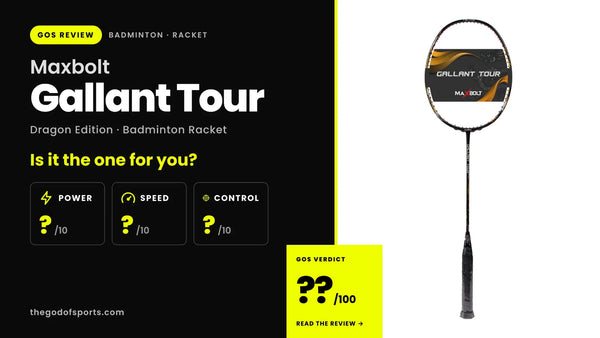 Maxbolt Gallant Tour Dragon Edition Badminton Racket Review — The Lighter 4U Gallant Tour
By GOS TeamOctober 21, 2026
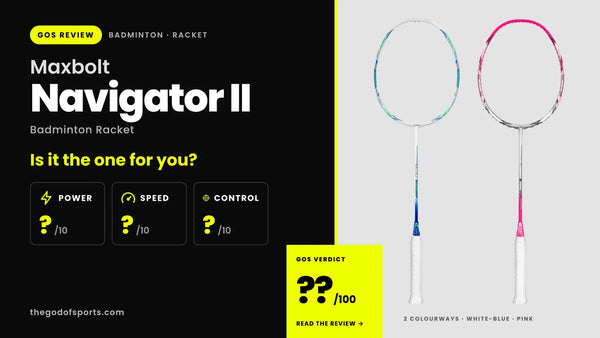 Maxbolt Navigator II Badminton Racket Review — Controlled Power for Improving Players
By GOS TeamOctober 21, 2026
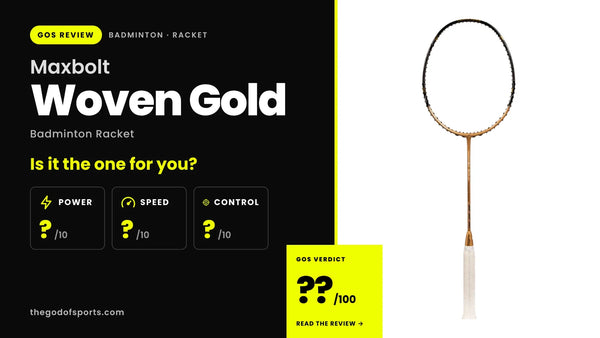 Maxbolt Woven Gold Badminton Racket Review — The Forgiving All-Rounder With No Weak Zone
By GOS TeamOctober 20, 2026
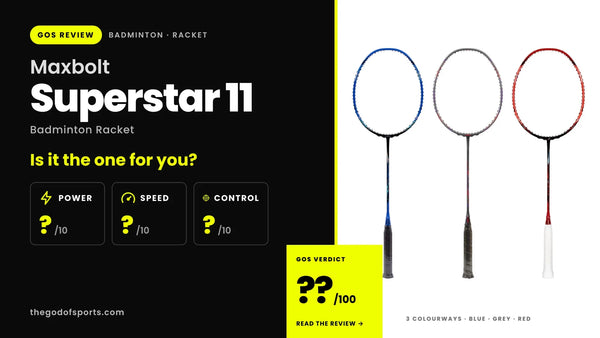 Maxbolt Superstar 11 Badminton Racket Review — One Racket for Every Part of the Rally
By GOS TeamOctober 20, 2026
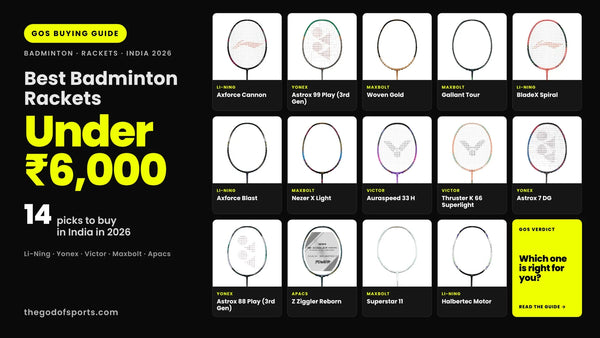 Best Badminton Rackets Under ₹6,000 in India 2026 - by God of Sports
By GOS TeamOctober 18, 2026
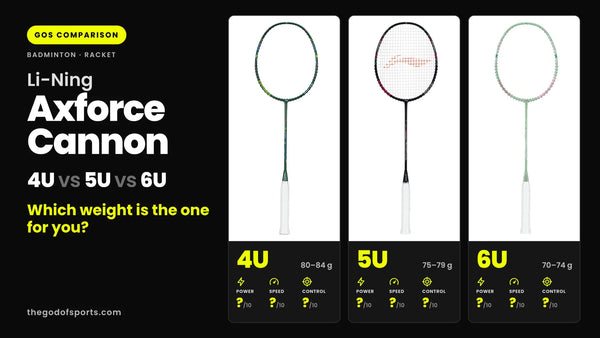 Li-Ning Axforce Cannon Review — 4U vs 5U vs 6U, Which Weight Is Right for You?
By GOS TeamOctober 18, 2026
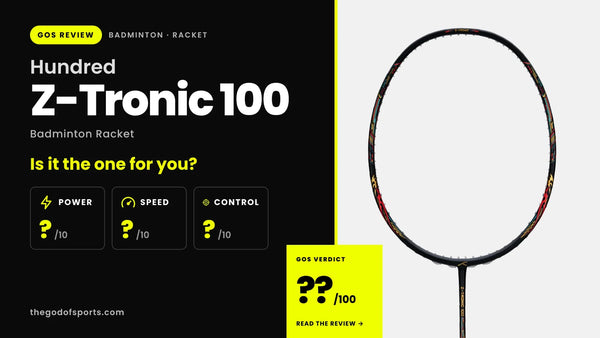 Hundred Z Tronic 100 Badminton Racket Review — A Slim, Stiff, Head-Heavy Smasher
By GOS TeamOctober 18, 2026
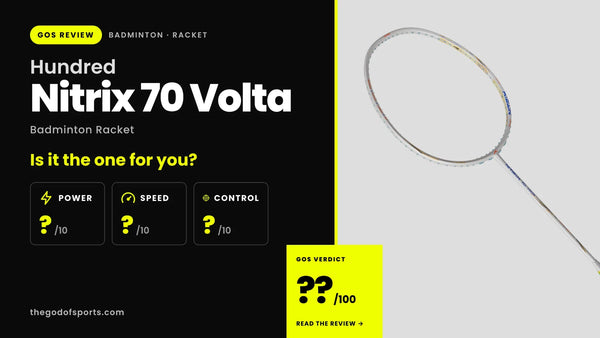 Hundred Nitrix 70 Volta Badminton Racket Review — Nitrix Smash Power with a Flexible Shaft
By GOS TeamOctober 18, 2026
 Yonex Astrox 99 Pro (3rd Gen) Badminton Racket Review — More Head Weight, Heavier Smashes
By GOS TeamOctober 18, 2026
 Li-Ning Axforce 90 Badminton Racket Review — Axforce Attack with an Easier-to-Time Shaft
By GOS TeamOctober 16, 2026